

Here is something almost nobody talks about.
The person with the scarcity mindset and the person with the abundance mindset can both end up in exactly the same place: stuck.
One builds a fortune and can’t enjoy it. The other visualizes a fortune and never builds it. One hoards. The other hopes. And neither is fully living.
The entire self-help industry has reduced this to a bumper sticker: scarcity bad, abundance good. Choose the right mindset and watch your life transform.
But that framing is wrong. It’s not just oversimplified—it’s actively misleading. Because scarcity thinking isn’t a defect. Abundance thinking isn’t a cure. And the most interesting research in psychology, neuroscience, and behavioral economics points to something far more nuanced, far more useful, and far more honest than “think positive and the universe provides.”
This is the deep dive that hasn’t been done.
Not a pep talk. Not a polarity. But the actual science of how these two orientations work, why they exist, where each one breaks down, and what a genuinely integrated approach might look like.
Two Ancient Strategies
Scarcity and abundance are not mindsets in the way most people use that word. They are not attitudes you select from a menu.
They are survival strategies—two ancient orientations that evolved because both were necessary.
Scarcity is the orientation of conservation. It says: protect what you have. Abundance is the orientation of expansion. It says: create what does not yet exist.
Every ecosystem in nature oscillates between these two modes. Seasons of conservation—winter, drought, dormancy—alternate with seasons of expansion—spring, rain, growth. No living system stays in one mode permanently. The ones that try don’t survive.
The oak tree drops its leaves in autumn not because it has failed, but because conservation is the intelligent response to a changing environment. It invests everything into growth in spring not because it is reckless, but because expansion is the intelligent response when conditions allow it.
The same is true for humans. But somewhere along the way, we decided one of these strategies was enlightened and the other was broken.
That’s the first mistake.
The Neurological Engine: Why Scarcity Is So Powerful
Before we can understand scarcity thinking, we need to understand why it dominates so easily.
In 1979, psychologists Daniel Kahneman and Amos Tversky published a paper in Econometrica that would reshape our understanding of human decision-making. Their prospect theory revealed something fundamental: we don’t weigh gains and losses equally. The pain of losing something is felt roughly twice as intensely as the pleasure of gaining the equivalent.
This asymmetry is not a flaw. It is an evolutionary feature. For our ancestors, the cost of missing a threat—death—far outweighed the cost of missing an opportunity—a meal. The brain evolved to prioritize loss avoidance over gain seeking. Survival depended on it.
This is the neurological engine of scarcity. It’s not irrational. It’s deeply, functionally rational—in the right context.
Loss aversion explains why people hold losing investments too long, why they resist change even when the status quo is painful, and why the fear of what might go wrong so often drowns out the excitement of what might go right.
It also explains why scarcity thinking is so persistent. You’re not battling a “mindset.” You’re working against millions of years of neural architecture that was designed, above all else, to keep you alive.
The Case for Scarcity
Scarcity has been unfairly maligned.
In its healthy form, it is what has kept human beings alive for hundreds of thousands of years. When resources are limited, attention sharpens. You prioritize. You focus. You conserve.
Scarcity is what makes a founder manage runway carefully. What makes a family build a financial buffer. What makes a pilot run the checklist twice.
It builds discipline. It protects against reckless overextension. Without some form of scarcity thinking, we would burn through resources, relationships, and energy with no thought for what comes next.
Scarcity, in this sense, is not weakness. It is intelligence. It is the part of us that says: not everything can be replaced. Some things must be protected.
The problem is not scarcity itself.
The problem is when it becomes the only mode.
The Shadow of Scarcity: The Bandwidth Tax
When scarcity becomes chronic, something shifts at the level of cognition itself.
In 2013, Harvard economist Sendhil Mullainathan and Princeton psychologist Eldar Shafir published Scarcity: Why Having Too Little Means So Much—a landmark work that changed how we understand the relationship between scarcity and the mind. Their research, published in Science, demonstrated that the mere experience of financial scarcity imposes a “bandwidth tax” on cognition equivalent to a drop of approximately 13–14 IQ points.
That is the same cognitive impairment as losing an entire night’s sleep.
To put it more starkly: it is the difference between testing in the “superior” intelligence range and “average”—or from “average” to “borderline deficient.”
But the most important finding was this: scarcity isn’t a trait. It’s a state. When Mullainathan and Shafir studied sugarcane farmers in Tamil Nadu, India, the same individuals performed significantly better on cognitive tests after harvest—when they had money—than before harvest, when they were broke. Same person. Same brain. Different financial context. Different cognitive capacity.
Scarcity doesn’t just influence what you think about. It changes how well you can think.
They called the mechanism “tunneling”—the way scarcity forces attention onto the immediate problem at the cost of everything else. Tunneling makes you sharper at solving the crisis right in front of you, but it degrades long-term planning, creative problem-solving, and big-picture thinking. Over time, this trade-off becomes self-reinforcing. You’re so consumed by the urgent that you can never attend to the important.
And this isn’t limited to financial poverty. The same tunneling effect appears in people who feel chronically time-poor, socially isolated, or emotionally depleted. Scarcity of any kind captures attention and narrows the field of vision.
This is the hidden architecture of the scarcity trap.
The Ferrari sits in the garage—not because it can’t be driven, but because driving it would mean risking it. And for someone locked in scarcity mode, the idea of loss is more real than the experience of enjoyment. The car becomes a symbol not of freedom, but of defense. A trophy that represents the ability to acquire, without the permission to enjoy.
Life becomes something to manage—rather than something to live.
The Case for Abundance: Broaden and Build
If scarcity narrows, abundance expands. And the science behind this is more robust than most people realize.
Barbara Fredrickson’s broaden-and-build theory, developed from the late 1990s onward, is one of the most well-supported frameworks in positive psychology. It demonstrates that positive emotional states—joy, interest, contentment, love—don’t just feel good. They functionally expand the range of thoughts, actions, and perceptions available to us.
Negative emotions narrow the behavioral repertoire. Fear produces flight. Anger produces attack. These are specific action tendencies—useful in crisis, constraining otherwise.
Positive emotions do the opposite. Joy sparks the urge to play and create. Interest sparks the urge to explore. Contentment sparks the urge to savor and integrate. Love sparks a recurring cycle of all these urges within safe relationships.
And here is what elevates this from feel-good theory to hard science: these broadened states don’t just feel expansive in the moment. They build durable resources over time—physical, intellectual, social, and psychological—that compound and accumulate, creating an upward spiral.
Fredrickson’s research showed that people experiencing positive emotions think more flexibly, recover faster from setbacks, see the big picture more readily, and build stronger social bonds. Her work also demonstrated that positive emotions can undo the physiological effects of negative emotions—literally accelerating cardiovascular recovery after stress.
This is the scientific foundation of abundance. Not wishful thinking. Not affirmations. But a documented, replicated finding that expansive emotional states produce expansive cognitive and behavioral outcomes.
The abundance orientation, at its best, is what allows you to try. To trust. To invest energy in things that do not yet exist. It is the orientation of creation, connection, and growth.
The Explanatory Style: Where Scarcity and Abundance Are Made
There is a deeper mechanism that determines whether a person defaults to scarcity or abundance, and it operates largely beneath conscious awareness.
Martin Seligman, the founder of positive psychology, spent decades studying what separates people who collapse under adversity from those who recover and grow. His answer: explanatory style—the habitual way you explain why things happen to you.
When something goes wrong, pessimists see the cause as permanent (“this will never change”), pervasive (“this ruins everything”), and personal (“it’s all my fault”). Optimists interpret the same setback as temporary (“this will pass”), specific (“this is one area”), and situational (“the circumstances were difficult”).
This matters for the scarcity-abundance conversation because explanatory style is the engine that drives the orientation. It is the mechanism through which an event becomes either evidence that the world is dangerous and resources are finite, or evidence that the setback is navigable and the future remains open.
The person who defaults to permanent, pervasive, personal explanations is building a scarcity architecture in real time. Every setback confirms the world view: things are scarce, I am inadequate, and it won’t get better. Attention narrows. Behavior contracts. The tunneling effect deepens.
The person who defaults to temporary, specific, situational explanations is building an abundance architecture. Every setback is contained: this is one thing, in one area, at one time. Attention stays broad. Options remain visible. Recovery is faster.
And the evidence for the downstream effects is striking. In a well-known study at MetLife, Seligman found that optimistic sales agents outsold pessimistic colleagues by 37%—even when conventional aptitude scores were equal. Broader research links optimistic explanatory style to lower depression, stronger immune function, reduced cardiovascular risk, and longer lifespan.
But here is the finding that matters most: explanatory style is learnable. It is not a fixed trait you are born with. Through structured cognitive techniques—identifying pessimistic interpretations, challenging them with evidence, generating more accurate alternatives—people can shift their default orientation.
Your position on the scarcity-abundance spectrum is not permanent. It is a habit. And habits can be changed.
The Shadow of Abundance: Manifestation and Its Discontents
Now for the part that the abundance community doesn’t want to hear.
Abundance thinking has a dark side, and it’s not just “overdoing it.” It’s a specific set of cognitive traps that can be just as imprisoning as scarcity—and, in some ways, harder to escape, because they feel so good.
The manifestation trap. The belief that visualizing an outcome is a meaningful substitute for building toward it. There is a kernel of truth here—positive expectancy does expand behavioral options and increase persistence. But the manifestation industrial complex has inflated this kernel into a theology: believe hard enough and the universe rearranges itself around your desire. The evidence says otherwise. Gabriele Oettingen’s research on mental contrasting has shown that pure positive fantasy about the future actually decreases motivation and effort. People who vividly imagine success feel the reward before doing the work—and are then less likely to do it.
The survivorship bias. Every manifestation success story is a sample of one—drawn from a population where the vast majority of people who visualized, affirmed, and believed just as fervently got nowhere. The stories that circulate are not evidence. They are selection effects. And they create a cruel implication: if it didn’t work for you, you must not have believed hard enough.
The spiritual bypass. Using “the universe has a plan” or “everything happens for a reason” as a sophisticated avoidance strategy. Legitimate grief gets reframed as “low vibration.” Reasonable caution gets dismissed as “fear-based thinking.” The language of abundance becomes a way to avoid engaging with painful realities rather than a way to navigate them.
The inverted helplessness. This is the most ironic trap. Seligman’s original research was on learned helplessness—the state where you stop trying because you believe your actions don’t matter. But a certain form of abundance thinking produces exactly the same outcome through a different door. If the universe is the agent of change, and your job is to believe and receive, then you are, functionally, helpless. You have outsourced agency to a cosmic force. You are waiting, not working. The result—passivity, dependency, inaction—is identical to learned helplessness, dressed in spiritual clothing.
Toxic positivity. The insistence that negative emotions are problems to be eliminated rather than signals to be understood. Fear, grief, anger, and doubt are not evidence of a scarcity mindset. They are data. And suppressing them in the name of “staying high-vibe” doesn’t eliminate the underlying reality—it just removes your ability to respond to it accurately.
Abundance without discipline is delusion. And while it feels warm, hopeful, and expansive in the moment, it rarely builds anything that lasts.
The Antifragility Bridge
There is a framework that resolves the tension between scarcity and abundance more cleanly than any other: Nassim Nicholas Taleb’s concept of antifragility.
Taleb distinguishes between three categories:
Fragile systems break under stress. They need protection, stability, and predictability. When disrupted, they get worse.
Resilient systems absorb stress. They hold together under pressure but don’t improve. They return to baseline.
Antifragile systems grow from stress. They need volatility and challenge to develop. When disrupted, they get stronger.
Chronic scarcity thinking is fragile. It organizes life around preventing disruption—rigid structures, defensive postures, a shrinking world. The implicit assumption: the system cannot handle challenge, so challenge must be avoided.
Abundance thinking, at its best, is antifragile. It orients toward growth through exposure, toward building capacity by engaging with uncertainty. The implicit assumption: challenges develop capability, so challenge should be embraced.
But Taleb is careful to note that antifragility doesn’t mean recklessness. The smartest approach is the “barbell strategy”—protect the core while taking asymmetric risks at the edges. Keep enough in reserve that nothing can destroy you, while investing in opportunities where potential upside dramatically outweighs the downside.
This is the integration point. Scarcity and abundance stop being opposites and start being partners.
Protect the foundation. Risk at the frontier.
The Wiring Beneath the Mindset
One of the least discussed dimensions of this conversation: not everyone starts from the same neurological baseline.
Research on Adverse Childhood Experiences (ACEs) has revealed that repeated exposure to stress in early childhood—abuse, neglect, household dysfunction, chronic instability—can reshape the developing brain’s architecture. The amygdala, the brain’s threat-detection center, becomes hyperactive. The prefrontal cortex, responsible for reasoning and regulation, shows impaired development. The hippocampus, which helps distinguish real threats from false alarms, can show reduced volume.
The result is a nervous system calibrated for threat. A brain that defaults to vigilance, that detects danger more quickly and relaxes more slowly, that is—in neurological terms—wired for scarcity.
This isn’t a character flaw. It’s an adaptation. A child growing up in an unpredictable environment needs a hair-trigger threat-detection system. Hypervigilance is intelligent when the environment is genuinely dangerous.
The problem is that this calibration persists long after the environment has changed. An adult who grew up with chronic instability may have the resources, relationships, and safety to operate from abundance—but their nervous system is still scanning for threats that no longer exist. They build the life but can’t relax into it. They accumulate but can’t enjoy. The Ferrari stays in the garage.
This adds an essential layer of honesty—and compassion—to the conversation. When we tell someone to “just think abundantly,” we may be asking them to override neural circuitry that was installed in childhood as a survival response.
Change is possible. Neuroplasticity is real. But it usually doesn’t come from an affirmation or a book. It comes from safe relationships, contemplative practice, therapeutic support, and the slow, patient work of teaching your nervous system that the world has changed.
The question isn’t “Which mindset will you choose?” as if it were a menu selection.
The more honest question is: What is your nervous system calibrated for, and how can you work with that wiring rather than pretending it doesn’t exist?
The Spillover Effect
Scarcity rarely stays in one domain.
Financial scarcity becomes time scarcity. “I don’t have enough money” quietly becomes “I don’t have enough time.” Then: “I don’t have enough energy.” Then: “I don’t have enough support.” The tunneling lens spreads, creating a generalized sense of insufficiency that becomes increasingly difficult to trace back to its origin.
But the reverse is also true.
Abundance in one area—especially belonging—can soften scarcity in another.
Someone with limited financial resources but deep relationships often experiences life very differently from someone wealthy but isolated. They still face constraints. But they don’t face them alone.
And that changes everything. The felt sense of support—I am not alone in this—is often the first thing that allows the nervous system to relax enough to shift from protection mode to exploration mode. Connection is the bridge between scarcity and abundance more often than money is.
Why Groups Need Both
There’s an evolutionary layer to this that’s easy to miss.
From a collective perspective, it would make little sense for everyone to be wired the same way. A tribe of pure risk-takers would burn through resources in a single season. A tribe of pure protectors would never explore beyond the valley. Survival has always depended on the balance between the explorer and the steward, the pioneer and the guardian.
This isn’t just a metaphor. It maps onto real variation in temperament, risk tolerance, and threat sensitivity across populations. Some people are neurologically predisposed to detect danger quickly and conserve. Others are predisposed to seek novelty and expand. The diversity isn’t a bug. It’s the strategy. A group that contains both orientations can protect what it has and reach for what it doesn’t — simultaneously.
This plays out in modern organizations just as it did on the savanna. High-performing teams consistently require a mix — those who stabilize and protect alongside those who innovate and explore. Too much protection and progress stalls. Too much expansion and systems break. The tension between the two isn’t dysfunction. It’s the engine. I dive deep into this dynamic in my FLAME workshops, based on a system I’ve called Human Operating Styles.
The problem arises when one orientation is celebrated and the other pathologized. When “abundance” is treated as enlightened and “scarcity” is treated as broken, we lose the essential friction that makes groups adaptive. We start selecting for one type and marginalizing the other — which is, ironically, the most fragile strategy of all.
The Values Pyramid: A Framework for Integration
We can map the relationship between scarcity and abundance onto a hierarchy of human values—one that also functions as a diagnostic tool for where you are and what’s keeping you stuck.
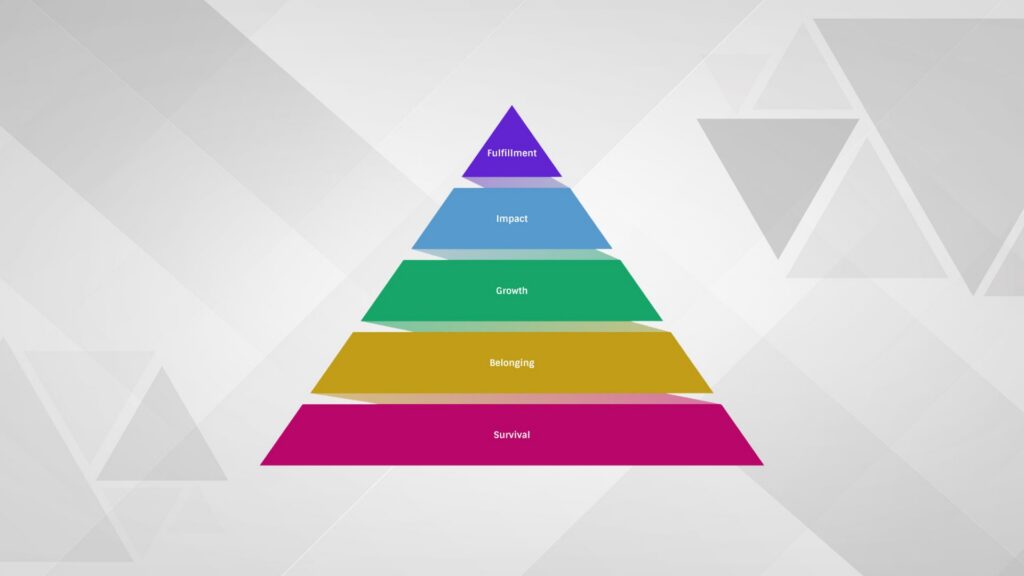
At the base: Survival. Money, safety, stability, physical security. This is where scarcity lives most naturally. When survival is threatened, the system contracts. Attention tunnels. Protection dominates. This is appropriate. You should operate from scarcity when survival is genuinely at stake.
Above survival: Belonging. Connection, love, community. This is the first level that requires moving beyond pure protection. You cannot build belonging while guarding everything. You have to open. You have to risk. This is where many people get stuck—they have the survival resources but can’t shift out of the protective mode long enough to invest in relationships.
Above belonging: Growth. Learning, development, expanding capacity. Growth requires something scarcity cannot provide: the willingness to be bad at something, to fail, to look foolish. Growth is inherently abundant—it assumes that current capacity is not the ceiling.
Above growth: Impact. Contribution, legacy, making a difference beyond yourself. Impact requires investing energy into outcomes you may never see. It requires the deepest form of abundance—the belief that giving does not deplete you.
At the summit: Fulfillment. Meaning, purpose, self-expression. The felt sense that your life matters. This cannot coexist with chronic scarcity. Fulfillment requires the courage to live beyond protection—to invest yourself fully, knowing that loss is possible, and choosing to engage anyway.
The pyramid works as a diagnostic: Where am I stuck, and what orientation is keeping me there?
If you can’t move from survival to belonging, the question is usually: What am I protecting so tightly that I can’t open up to connection?
If you can’t move from belonging to growth, the question is: Where am I so comfortable that I’ve stopped challenging myself?
If you can’t move from growth to impact, the question is: Am I still accumulating for myself, or am I ready to invest in something larger?
Each transition requires a shift from scarcity toward abundance. And each transition is a choice—not a permanent identity, but a deliberate reorientation.
The Integrated Path
So where does this leave us?
Not with a bumper sticker. Not with “choose abundance.” Not with a vision board.
But with something more powerful: a dynamic practice.
The wisest approach is not to pick a side. It is to develop the flexibility to move between orientations—deliberately, skillfully, and without getting stuck in either one.
The barbell in practice:
Protect the core. Build the financial buffer. Manage the risks. Run the checklist. Honor the scarcity intelligence that keeps the foundation solid. This is not fear. This is stewardship.
Expand at the edges. Take the creative risk. Build the relationship. Launch the project that might fail. Invest energy in things that don’t yet exist. This is not recklessness. This is growth.
Know the season. There are times for conservation and times for expansion. Times to hold and times to reach. The person who can read the season accurately and shift accordingly has an enormous advantage over the person who is locked in one mode regardless of conditions.
Understand your wiring. If your nervous system was calibrated for threat early in life, that’s not a failure—it’s information. Work with it. Get support. Build safety slowly. Don’t expect a mindset shift to override neurology.
Watch the spillover. When scarcity appears in one domain, notice whether it’s spreading. When abundance shows up, notice whether it’s grounded in action or floating on fantasy.
Because the truth—the actual, evidence-based truth—is this:
Scarcity is not your enemy. It is a tool. Use it where it serves you—at the foundation, in the core, during the winter.
Abundance is not your savior. It is also a tool. Use it where it serves you—at the frontier, in the creative space, during the spring.
And wisdom is the ability to hold both—to move between them fluidly, to deploy each one where it belongs, and to refuse the false comfort of choosing a side.
Scarcity keeps you alive.
Abundance makes life worth living.
The integrated life requires both.
Brad Hook is the author of Start With Values (Penguin, 2025), founder of the Values Institute, and creator of FLAME. He has spent two decades in human performance consulting for organizations including PwC, Shell, Electronic Arts, and Fonterra.
References
- Kahneman, D., & Tversky, A. (1979). Prospect theory: An analysis of decision under risk. Econometrica, 47(2), 263–292.
- Mani, A., Mullainathan, S., Shafir, E., & Zhao, J. (2013). Poverty impedes cognitive function. Science, 341(6149), 976–980.
- Mullainathan, S., & Shafir, E. (2013). Scarcity: Why Having Too Little Means So Much. Henry Holt and Company.
- Fredrickson, B. L. (2001). The role of positive emotions in positive psychology: The broaden-and-build theory of positive emotions. American Psychologist, 56(3), 218–226.
- Fredrickson, B. L., & Branigan, C. (2005). Positive emotions broaden the scope of attention and thought-action repertoires. Cognition and Emotion, 19(3), 313–332.
- Seligman, M. E. P. (1991). Learned Optimism: How to Change Your Mind and Your Life. Knopf.
- Oettingen, G. (2012). Future thought and behaviour change. European Review of Social Psychology, 23(1), 1–63.
- Taleb, N. N. (2012). Antifragile: Things That Gain from Disorder. Random House.
- Dweck, C. S. (2006). Mindset: The New Psychology of Success. Random House.
- Felitti, V. J., et al. (1998). Relationship of childhood abuse and household dysfunction to many of the leading causes of death in adults. American Journal of Preventive Medicine, 14(4), 245–258.