
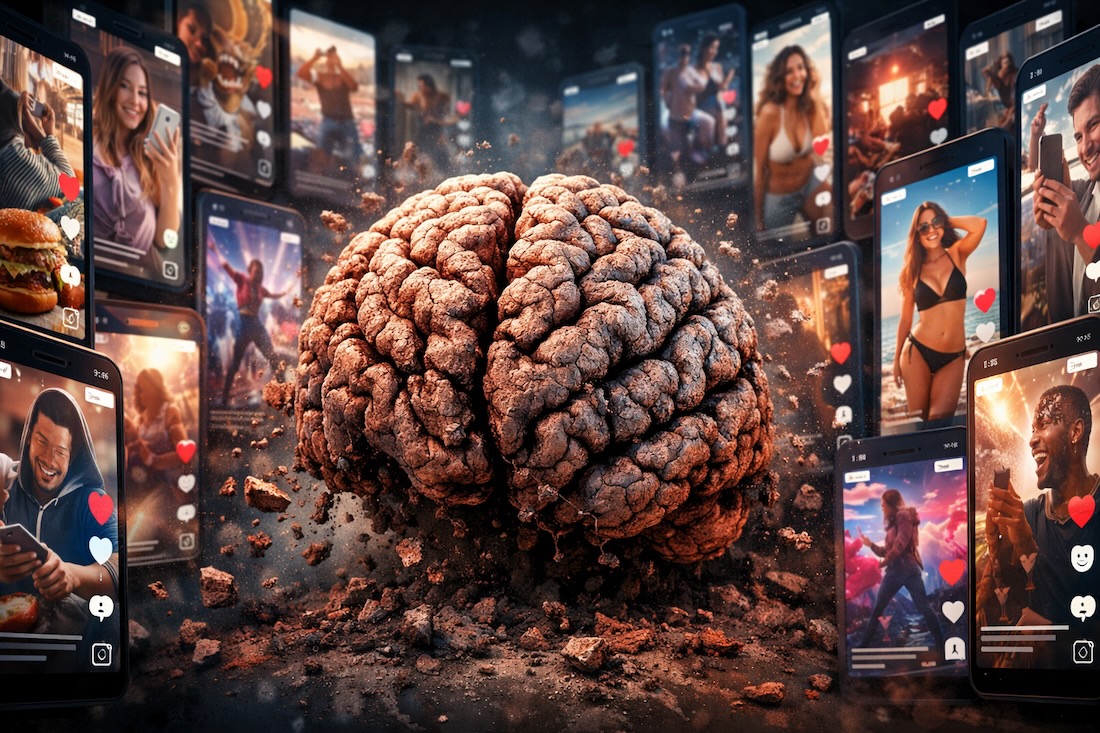
If you’ve searched for “Jonathan Haidt brain rot” or watched the recent Diary of a CEO brain rot episode, you’re not alone.
The term “brain rot” is everywhere right now.
But is it real?
According to Jonathan Haidt, yes. And it’s bigger than we think.
In his conversation with Dr. Aditi Nerurkar on Diary of a CEO, they argue that short-form video, algorithm-driven social media, and emerging AI companions are actively reshaping our brains.
Below is a breakdown of the episode — and what it means for your attention, your children, and your future.
Watch the Full Brain Rot Episode
What Is Brain Rot?
Brain rot refers to the cognitive decline associated with constant short-form digital stimulation.
It includes:
- Reduced attention span
- Weaker impulse control
- Increased distractibility
- Poorer sleep
- Mental fatigue
In simple terms:
Your brain adapts to rapid dopamine hits.
And then struggles with depth.
Brain rot isn’t stupidity. It’s the erosion of sustained attention.
Jonathan Haidt: The Destruction of Attention
Haidt originally focused on rising anxiety and depression in Gen Z. His book The Anxious Generation explored how social media affected teen mental health.
But he now believes the damage runs deeper.
It’s not just about mood.
It’s about cognition.
He argues that short-form video is uniquely destructive because it conditions the brain through rapid reinforcement cycles.
Swipe.
Reward.
Swipe.
Maybe reward.
This mirrors variable reinforcement — the same mechanism used in slot machines.
Television transported you into stories.
Short-form video trains your brain to expect novelty every few seconds.
That difference matters.
Every scroll is a vote for the brain you are becoming.
The Neuroscience of Brain Rot
Dr. Aditi Nerurkar explains what’s happening biologically.
Two key brain systems are involved:
1. The Amygdala
Your threat detector. Activated by stress and novelty.
2. The Prefrontal Cortex
Responsible for impulse control, planning, focus, and strategic thinking.
When you engage in high-volume, rapid short-form content:
- The amygdala becomes hyperactivated.
- The prefrontal cortex downregulates.
Over time, this weakens executive function.
Heavy short-form video use has been associated with:
- Shorter attention spans
- Reduced cognitive endurance
- Greater impulsivity
- Poorer sleep quality
- Increased anxiety
This isn’t harmless entertainment.
It’s neuroplastic training.
Attention is not something you have. It’s something you train.
Is TikTok Causing Brain Rot?
This is one of the most searched questions right now.
Haidt argues that platforms like TikTok optimized their algorithms for maximum retention.
The algorithm doesn’t care who you are.
It cares about engagement.
The result?
Extreme personalization.
High dopamine density.
Continuous novelty.
If your brain adapts to 10-second bursts of stimulation, sustained focus becomes harder.
And that affects everything from studying to relationships to long-form thinking.
Brain Rot in Children: Why Haidt Says Zero Is the Right Number
Haidt is clear when it comes to children.
He believes short-form vertical video should not be part of childhood.
Why?
Because childhood is when executive function develops.
Kids need:
- Boredom
- Friction
- Delayed gratification
- Real-world play
- Face-to-face interaction
If the developing brain is trained on constant micro-rewards, it struggles to build tolerance for effort.
And effort is where mastery lives.
If we remove boredom from childhood, we remove the soil in which resilience grows.
Revenge Bedtime Procrastination: The Adult Brain Rot Trap
This episode also highlighted something many adults quietly experience:
Revenge bedtime procrastination.
You finish work.
You deserve “me time.”
You scroll.
Suddenly it’s 1:30 a.m.
Your sleep suffers.
Your mood drops.
Your willpower declines the next day.
Sleep disruption alone increases risk of:
- Depression
- Burnout
- Cardiovascular disease
- Emotional dysregulation
Brain rot compounds itself.
We think we’re decompressing. Often we’re just rehearsing distraction.
AI Companions: The Next Phase of Brain Rot?
The conversation then moved beyond short-form video.
If social media hacked attention, AI may hack attachment.
AI chatbots are increasingly used for:
- Therapy
- Emotional support
- Companionship
Haidt warns that this could reshape how humans form bonds.
If AI becomes more responsive than friends, more available than partners, and more affirming than parents, what happens to real relationships?
And when monetization enters that attachment dynamic?
The incentives get complicated.
When engagement becomes the business model, depth becomes a threat.
Is Brain Rot Permanent?
No.
The brain is plastic.
Neuroplasticity works both ways.
Dr. Nerurkar suggests practical interventions:
- Remove short-form apps from your phone
- Keep your phone out of arm’s reach
- Grayscale your device
- Create device-free zones
- Embrace boredom intentionally
New neural pathways typically require about eight weeks of consistent change.
Which means:
Attention can be rebuilt.
But it must be practiced.
Why This Episode Matters
The Diary of a CEO brain rot episode resonated because it named what many people already feel:
- Fragmented focus
- Constant stimulation
- Deeper loneliness
- Reduced cognitive endurance
This isn’t nostalgia for a pre-digital world.
It’s a question of human capacity.
If we lose sustained attention, we lose:
- Complex thought
- Deep work
- Long-form creativity
- Meaningful dialogue
And perhaps even parts of ourselves.
FAQs About Brain Rot
Is brain rot real?
Yes. Research increasingly shows associations between heavy short-form digital consumption and reduced attention span and impulse control.
Did Jonathan Haidt say brain rot is real?
On The Diary of a CEO, Haidt argued that short-form video is destroying sustained attention and reshaping cognition.
Is TikTok causing brain rot?
While causation is still being studied, algorithm-driven short-form platforms are strongly associated with shorter attention spans and dopamine-driven habit loops.
Can brain rot be reversed?
Yes. Attention can be rebuilt through intentional boundaries, reduced stimulation, improved sleep, and deliberate focus training.
Final Reflection
I work online. I create content. I understand algorithms.
But here’s the question I keep returning to:
If we scale attention fragmentation, what are we actually building?
If you removed short-form video for 30 days…
What might return?
Sleep?
Clarity?
Conversation?
Creativity?
Or simply silence?
And maybe that silence is not emptiness.
Maybe it’s the beginning of depth again.