

Right now, as you read this, there are more than 50 active armed conflicts burning across the globe. The war in Ukraine grinds into its fifth year. The Middle East remains engulfed in violence that has reshaped the region. Sudan’s civil war has displaced over 10 million people in what the UN calls the world’s worst humanitarian crisis. Myanmar, the Congo, the Sahel — the list goes on.
And even if you’re thousands of miles from the nearest frontline, you feel it. In the fuel prices that keep climbing. In the news alerts that won’t stop. In the footage — some real, some AI-generated, all of it overwhelming — that floods your feed before you’ve finished your morning coffee.
I’ve spent over a decade working in the field of resilience, supporting people through crises ranging from California wildfires to natural disasters in my home of Mount Maunganui, New Zealand. I grew up in South Africa during a period when hearing helicopters circling at night and gunshots in nearby suburbs was simply what life sounded like. It wasn’t a war zone, but it carried the same relentless quality that makes prolonged crisis so psychologically demanding: there was no clear end in sight.
What I’ve learned — from the research, from the wisdom traditions, and from sitting with real people in real pain — is that resilience in crisis is not about toughness. It’s about having a practical toolkit that helps you regulate your nervous system, protect your relationships, and stay connected to what matters most. Whether you’re directly affected or watching from a distance, the biology of stress doesn’t care about geography. Your body responds to threat either way — just at different intensities.
This guide is for both audiences.
Part One: Understand Your Nervous System (It’s Trying to Protect You)
The single most important thing to understand about crisis is that your body’s stress response is not a malfunction. It’s a survival mechanism that evolved over millions of years to keep you alive. The challenge is that this system was designed for acute threats — a predator, a rival, a storm — not for the chronic, ambient stress of modern conflict and 24/7 news cycles.
Stephen Porges’ polyvagal theory offers a useful framework. While debated in its finer scientific details, the clinical model is widely used by trauma therapists and offers an accessible map of how your autonomic nervous system shifts between three broad states.
Ventral vagal (safe and social): You feel calm, connected, and present. You can think clearly, engage with others, and access creativity and humor. Your breathing is easy, your muscles are relaxed.
Sympathetic activation (fight or flight): You feel anxious, angry, restless, or hypervigilant. Your heart rate increases, your breathing becomes shallow, and your body is mobilizing energy for action. You might snap at loved ones, feel a constant urge to scroll the news, or find yourself unable to sit still.
Dorsal vagal (freeze or shutdown): You feel numb, disconnected, exhausted, or hopeless. It’s the body’s last-resort defense — metabolic conservation in the face of overwhelm. You might find yourself sleeping excessively, unable to make decisions, or emotionally flat.
Recognizing which state you’re in is the first step toward doing something about it. The emotions are the signal: irritability and racing thoughts suggest sympathetic activation. Flatness, withdrawal, and a sense that nothing matters suggest dorsal shutdown.
Part Two: Understand What Happens to Your Values in Crisis
Here’s something most people don’t talk about when it comes to resilience: crisis doesn’t just change how you feel. It changes what you care about — and understanding that shift can save you an enormous amount of unnecessary suffering.
In my book Start With Values, I describe a values pyramid with five levels. At the base sits survival — safety, security, basic needs. Above that, belonging — connection, love, being part of a group. Then growth — learning, development, stretching yourself. Then impact — contribution, influence, leaving a mark. And at the top, fulfillment — meaning, purpose, transcendence.
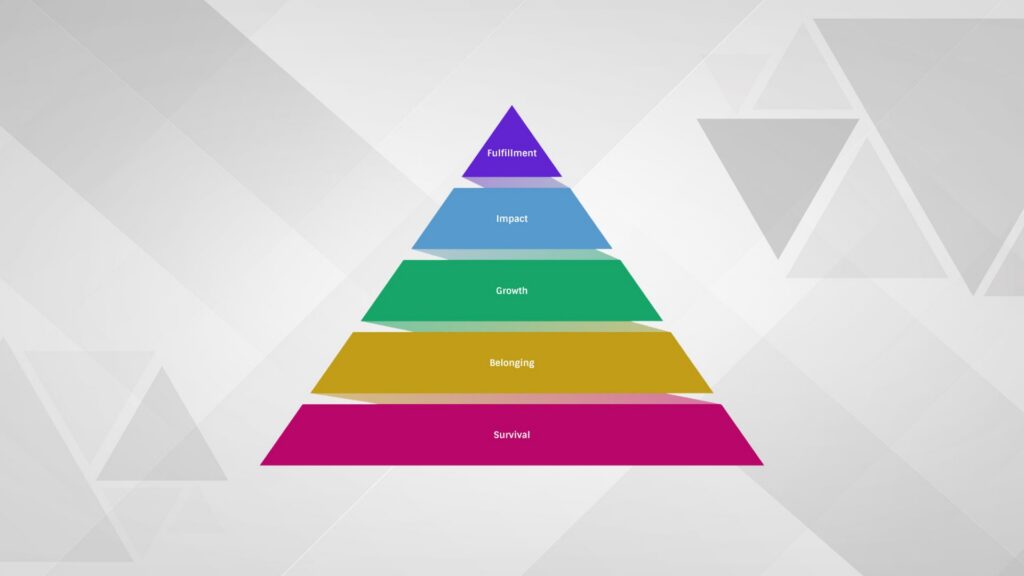
In ordinary life, most of us navigate somewhere in the middle or upper reaches of this pyramid. We’re thinking about career growth, creative expression, making a difference. But when crisis hits — when the ground literally or figuratively shakes — the pyramid narrows. Your nervous system pulls you toward the base. Survival values flood in: Am I safe? Are the people I love safe? Where is the next meal coming from?
This is not weakness. It’s biology. It’s the same mechanism that helped our ancestors survive famine, migration, and conflict for millennia.
The problem comes when you don’t recognize the shift. If you’re in a crisis zone and simultaneously trying to maintain your status-oriented goals, your growth targets, or even your altruistic commitments at full intensity, you’ll create an internal conflict that amplifies distress. You’ll feel like you’re failing at everything, when in reality, you’re just trying to operate at the wrong level of the pyramid for your current circumstances.
Give yourself permission to be at the base. Survival mode is not a lesser mode. It’s the foundation that everything else is built on. Let the higher values go temporarily. They’ll be there when you’re ready.
And here’s the counterpoint — and it’s equally important. As soon as conditions allow even a small window of stability, reconnecting with values higher on the pyramid can be profoundly restorative. A simple question — Can I be kind right now? Can I be family-oriented? Can I do one thing that reflects who I actually want to be? — redirects attention from threat to purpose. It re-engages the prefrontal cortex, the part of the brain that crisis tends to shut down. Higher values, even in small doses, restore a sense of agency and guide clearer decision-making.
This oscillation — dropping to survival when you need to, reaching back toward meaning when you can — is the rhythm of resilience. It’s not a failure to shuttle between the two. It’s how it works.
Part Three: If You’re Directly Affected
If you are in or near a crisis zone — whether that’s a conflict, a natural disaster, or any situation where your physical safety is under active threat — here is what the evidence tells us works.
Shrink the Time Horizon and Focus on What You Can Control
These two ideas are really one idea, and together they form the most powerful reframe available to anyone under acute stress: narrow your focus to the immediate, and direct your energy only toward what you can actually influence.
The Stoic philosopher Epictetus, himself a former slave, taught this with brutal clarity: distinguish ruthlessly between what is up to you and what is not. You cannot control the bombs, the earthquake, or the decisions of governments. But you can control whether you drink water, whether you check on your neighbor, whether you speak calmly to your children.
Military psychologists have long understood that this combination — a compressed time horizon and a tight focus on controllable action — is one of the strongest predictors of psychological resilience under extreme pressure. Perhaps the most vivid illustration comes from Ernest Shackleton’s Antarctic expedition of 1914–1916. When his ship Endurance was crushed by pack ice, stranding 28 men in the most inhospitable place on Earth, Shackleton did something that most leaders cannot bring themselves to do: he let go of the original mission entirely. No more crossing the continent. The new mission was simple: get everyone home alive.
What happened next is instructive. Shackleton organized routines, assigned specific tasks, encouraged games and singing, and kept his men focused on the immediate — the next meal, the next task, the next decision. He even saved a banjo while discarding other essentials, understanding that morale was as critical as calories. When he noticed a crew member’s negativity threatening group cohesion, he moved that person into his own tent. He managed energy, not just logistics.
After nearly two years on the ice, every single one of his 28 men survived. It remains one of the greatest leadership stories in history, and the mechanism is exactly the values pyramid in action: Shackleton dropped to survival, built belonging through shared purpose and structure, and in doing so created the conditions for his men to endure what should have been unsurvivable.

The sphere of influence model makes the principle concrete for any of us. You have three zones: what you directly control (your actions, your words, your attitude), what you can influence (those close to you, your immediate community), and what lies beyond your control (geopolitics, weather, other people’s decisions). In crisis, pour your energy into the inner circle. That’s where your agency lives.
Ask yourself: What is the one thing I can do right now? Even if it’s just one long, slow exhalation to calm the nervous system. That counts. Start there.
Regulate First, Then Plan
Before you can think clearly, you need to calm the nervous system. This isn’t a luxury — it’s neuroscience. When your sympathetic system is fully activated, your prefrontal cortex (the thinking, planning part of your brain) goes partially offline. You literally cannot make good decisions while your body thinks it’s about to die.
The simplest tool: Extended exhale breathing. Breathe in for a count of four, out for a count of six to eight. The exhale activates the vagus nerve, which sends a signal to your brain that you are safe enough to think. It’s the physiological equivalent of applying the brakes. This is the technique taught to military special forces, first responders, and emergency room physicians, and you can do it anywhere, in any situation, without anyone knowing.
If you feel numb or disconnected (dorsal vagal shutdown), try engaging your senses. Feel your feet on the floor. Hold something cold. Name five things you can see. These aren’t tricks — they’re ways of telling your nervous system that you’re here, you’re alive, and the present moment is survivable.
Name Your Emotions and Connect
Research from UCLA neuroscientist Matthew Lieberman shows that simply labeling an emotion — “I’m scared,” “I’m angry,” “I feel helpless” — reduces activity in the amygdala, the brain’s threat-detection center. In psychology, this is sometimes called “name it to tame it.” It works because it re-engages the prefrontal cortex.
Don’t do this alone. Reach out for support and be willing to support others.
During WWII, something remarkable happened: despite the relentless bombing of the Blitz, formal psychiatric admissions in Britain did not increase appreciably. A London clinic set up specifically to treat air-raid trauma had to close — because no patients came. In 1942, psychiatrist R.D. Gillespie wrote that one of the most striking observations of the war was the relative rarity of psychological breakdown among civilians exposed to bombing. Researchers attribute this largely to the extraordinary social cohesion that emerged under shared threat. People volunteered, organized, shared shelters, and looked after each other. The “Blitz spirit” was partly propaganda — the reality was more nuanced, and working-class communities bore a disproportionate burden — but the underlying finding is robust: collective adversity, when met with genuine connection, is psychologically protective.
We see the same pattern in more recent history. During the Siege of Sarajevo — 1,425 days, the longest siege of a capital city in modern warfare — something counterintuitive emerged. As war became daily life, a parallel world appeared. People went back to work. Musicals and film screenings were organized in basements. Theater became, in the words of survivors, as important as food and water. Neighbors who had barely spoken before the siege formed deep support networks, pooling resources across ethnic lines. One survivor described the early period as paradoxically meaningful — people connected more deeply than they ever had in peacetime. The creative resistance didn’t just preserve sanity. It preserved identity. It said: we are more than this war.
Belonging buffers stress. In crisis, connection isn’t a nice-to-have. It’s survival infrastructure.
Create Psychological Safety Within Your Group
If you have children, elderly parents, or anyone vulnerable in your care, your most important job is to create a sense of emotional safety within your family or group — even when the external conditions are unsafe.
This doesn’t mean pretending everything is fine. Children are remarkably perceptive; they know when you’re lying. Instead, share the situation honestly at an age-appropriate level. Name the shared reality: “This is scary for all of us, and we’re going to get through it together.” Nothing builds trust faster in a crisis than being honest about what you’re facing while demonstrating calm leadership.
Keep routines where possible. Eat together. Tell stories. Light a candle. Sing. Structure is a signal of safety — it tells the nervous system that someone is in charge and the world still has order, even when evidence to the contrary is all around you.
There’s a revealing pattern here that extends beyond families. In times of crisis, leaders suddenly start talking about values and purpose — the very things that are often dismissed as fluffy or aspirational during peacetime. But crisis strips away the pretense. When survival is at stake, values become functional. Whether the rallying point is survival itself, unity, care, or the promise of shared prosperity, naming what matters gives a group a shared direction. Values are not soft. They are the operating system that communities default to when everything else fails. Sarajevo’s residents understood this instinctively — they held together not through military strategy alone, but through a shared commitment to the multicultural identity of their city.
Recover Where You Can
Even in extreme situations, recovery matters. Sleep deprivation alone degrades decision-making, emotional regulation, and immune function. If you can sleep, sleep. If you can eat, eat well. If you can move your body, even briefly, do it — the stress response mobilizes energy for physical action, and if you don’t discharge it, it stays locked in your system as chronic tension.
Acceptance and Commitment Therapy (ACT) offers a useful framework here: accept what you cannot change (the reality of the situation), connect with your values (what matters most to you), and commit to actions aligned with those values — however small. It’s not about positive thinking. It’s about purposeful action in the face of pain.
The Legacy Reflection
When things are at their worst, there is a question that can cut through the noise with surprising clarity: How would I like to remember handling this?
Not “How do I fix this?” — that question is often too big. But “What kind of person do I want to have been in this moment?” — that question reaches into the identity level, past the fear and the exhaustion, and connects you with something deeper. It draws on the values higher up the pyramid — impact, fulfillment, meaning — without demanding that you operate there full-time. It’s a momentary lift, a breath of altitude.
I’ve seen people in crisis use this reflection as an anchor. It doesn’t change the external situation. But it changes the internal one. And in crisis, the internal situation is the only territory you fully control.
Part Four: If You’re Watching from a Distance
You’re not in the conflict zone, but you’re not unaffected either. Perhaps you have loved ones in harm’s way. Perhaps the economic ripple effects — rising fuel prices, supply chain disruptions, market instability — are hitting your household. Perhaps you’re simply human, and watching suffering at scale takes a toll.
The nervous system doesn’t distinguish cleanly between direct threat and perceived threat. Doomscrolling through graphic footage activates many of the same stress pathways as being there. The difference is that you don’t get the adrenaline discharge of physical action, and you don’t get the protective bonding of shared adversity. You get the stress without the release. That’s a recipe for chronic burnout.
Manage Your Information Diet
Stay informed, but deliberately. Choose one or two trusted news sources and set specific times to check them. Unsubscribe from push notifications. Be especially skeptical of content that triggers extreme emotional reactions — that’s often by design, whether the source is a human editor or an algorithm.
In a world of polarized media and AI-generated content, verify before you share. The misinformation that circulates during conflict causes real harm to people on the ground.
Build in Recovery
If you’re going to absorb the weight of the world’s suffering, you need to actively counterbalance it. This isn’t selfish — it’s maintenance. A burned-out, emotionally depleted ally is no use to anyone.
Breathwork applies equally here. Five minutes of extended exhale breathing before bed can meaningfully improve sleep quality and nervous system regulation. Journaling — even three sentences about how you’re feeling — provides the same “name it to tame it” benefit as talking to a friend. And movement completes the stress cycle: a walk, a swim, a surf, a dance in the kitchen — it doesn’t matter what. What matters is that the energy moves through you rather than staying stuck.
Address the Guilt
Distance guilt is common and corrosive. The thought pattern is: “How can I enjoy my life when people are suffering?” Left unchecked, it leads to chronic low-grade distress that helps no one.
Notice what’s happening on the values pyramid: guilt often arises because your higher values — compassion, fairness, contribution — are activated, but you feel unable to act on them. The gap between caring and doing becomes its own source of pain.
The ACT approach is useful here. Notice the guilt without being consumed by it. Acknowledge it as a sign that you care — because it is. Then ask: What action can I take that aligns with my values? Donate. Volunteer. Have a difficult conversation. Write to your elected representative. Use your privilege purposefully. Guilt metabolized into action becomes contribution — and contribution is one of the most reliable ways to climb back up the values pyramid.
Stay Connected
Isolation amplifies anxiety. The research is unambiguous on this. After the Allied bombing of German cities in WWII, the communities that suffered the least psychological damage were not the ones with the least physical destruction — they were the ones with the strongest social ties. Community is medicine.
Check in with friends and family. Have conversations that go beyond surface level. If you’re struggling, say so. If someone else is struggling, listen without trying to fix.
Part Five: Beyond Resilience — The Antifragile Mindset
I want to finish by pushing beyond resilience itself.
The standard framing of resilience is: absorb the shock and return to normal. And that’s valuable. But Nassim Nicholas Taleb introduced a more powerful concept: antifragility — the property of systems that actually gain from disorder. Not just surviving the storm, but emerging stronger because of it.
Some systems are fragile — they break under stress. Some are resilient — they withstand it. But antifragile systems use stress as raw material for growth. A bone that heals from a fracture becomes denser at the break point. An immune system exposed to pathogens builds defenses it didn’t have before.
This is a mindset worth cultivating. Not because crisis is good — it isn’t, and it produces real suffering. But because within crisis, there is a possibility that doesn’t exist in comfort: the possibility of transformation. Every story in this article points to it. Shackleton’s crew became more tightly bonded than any peacetime expedition could have produced. Sarajevo’s residents discovered depths of community and creativity that ordinary life had never required of them. The Blitz generation in Britain built the social cohesion that, by many accounts, laid the foundation for the welfare state and the National Health Service.
Viktor Frankl, the Austrian psychiatrist who survived Auschwitz and went on to develop logotherapy, built an entire therapeutic approach on this insight. He observed that those who survived the camps were often not the physically strongest, but those who held onto a reason to live — a loved one to return to, a task to complete, a story to tell. Frankl came to believe that the primary human drive isn’t pleasure or power, but meaning. And meaning is most urgently sought — and most profoundly found — in suffering.
This is where the values pyramid becomes not just a diagnostic tool but a compass. Survival values keep you alive. But it is the upper reaches of the pyramid — the drive toward impact, fulfillment, and purpose — that keep you human. The ability to shuttle between the two, to drop to the base when you must and reach for the heights when you can, is not just resilience. It is the full expression of what it means to be alive under difficult conditions.
The world is turbulent. It may remain so for some time. But within that turbulence, you have more agency than you think — and more potential for growth than you might imagine. Start with the breath. Start with one another. And when you’re ready, ask the question that matters most: Who do I want to be in this?
That’s enough. That’s always been enough.