
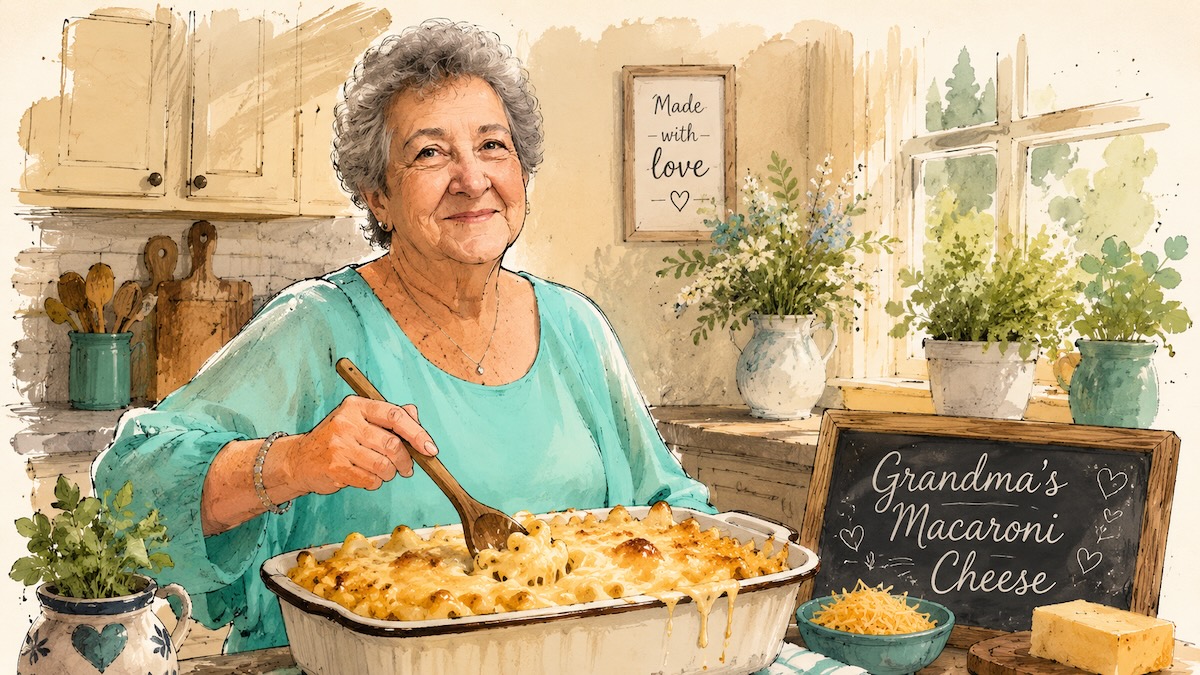
I was lucky enough to have two grandmothers. Because my mother and father were very young when I was born, my grandparents were still in their forties when I was a kid, which meant they were full of life, and they were wonderful teachers and guides.
I lived with my grandparents on my mother’s side several times over the course of my childhood. My grandmother, May — who we called Nan — ran a kitchen that we loved: macaroni cheese that turned pink from a squirt of ketchup, one-minute microwave cakes, and onions she hand-chopped so fine you could never find a single piece.
But the cooking was only part of it. Nan was a well of wisdom. There wasn’t a situation she didn’t have some advice for. Eat your vegetables. Go for a walk after dinner. Sit up straight. Have some soup, you’ll feel better.
If you were lucky enough to have a grandmother, you’ll know that this kind of wisdom carries along a thread, from mother to daughter, from daughter to the next generation. Perhaps it is the truest thread that has kept humanity alive for thousands of years. The herbs that worked. The practices that gave energy. The lessons learned, and the whispers of advice handed down.
So I decided to research some of the most popular pieces of grandmotherly wisdom. And I found that grannies really are right. Not just once, but most of the time. One by one, in controlled trials, meta-analyses, and journals with names your grandmother might not be able to pronounce, science has backed the claims.
Nan was right about a lot of stuff! And she was the best.

Here’s the wisdom the science now backs, grouped the way your grandmother (or mine) might have organised her day: first the kitchen, then the daily rhythm, then the wisdom of the heart. A few things she got wrong are at the end, in fairness.
Part one: the kitchen and the medicine cabinet
“Have some chicken soup, it’ll do you good.”
The most charming vindication on this list. In 2000, a pulmonary specialist at the University of Nebraska Medical Center decided to test his wife’s grandmother’s chicken soup recipe in an actual laboratory. The recipe, named in the published paper as “Grandma’s soup,” went head to head with science.
The result: the soup slowed the movement of neutrophils, the white blood cells that drive the inflammation behind your cold symptoms. The team found the effect was concentration-dependent, the signature of a real mild anti-inflammatory action rather than a fluke. Every vegetable in the pot contributed something. Grandma’s intuition held up under a Boyden blindwell chemotaxis chamber assay, which is about as far from her kitchen as a remedy can travel and still come home a winner.
So the next time someone brings you soup when you’re sick, know there’s a paper in the journal Chest with your back.
“A spoon of honey for that cough.”
This one even beat the pharmacy. A Cochrane review, the gold standard for weighing up medical evidence, pooled randomised trials of honey against the usual cough remedies in children. The verdict: honey reduced cough frequency and severity better than no treatment, improved sleep for both child and parent, and performed about as well as dextromethorphan, the active ingredient in many over-the-counter cough syrups.
A spoonful from the pantry, holding its own against the cough-and-cold aisle. One important caveat her era did not know: never give honey to a baby under one, because of the risk of infant botulism. For everyone else, the jar wins.
“Ginger settles the stomach.”
Feeling queasy? Grandma reached for the ginger, and the evidence reached the same conclusion. Multiple meta-analyses have found ginger genuinely helps with nausea. A pooled analysis of trials found that at least a gram of ginger beat placebo at preventing post-operative nausea and vomiting. Separate reviews found it useful for the nausea of early pregnancy, where many women want to avoid conventional drugs.
The mechanism turns out to be real chemistry: compounds in ginger called gingerols and shogaols act on the same serotonin receptors that some anti-nausea medications target. Grandma was doing pharmacology without the lab coat.
Part two: the rhythm of the day
“Early to bed, early to rise makes you healthy, wealthy, and wise.”
The headline act, and modern sleep science backs its spirit firmly. Going to bed earlier and keeping a consistent rhythm aligns you with your body’s circadian biology, and adequate sleep is now tied to better mood, sharper thinking, healthier weight, and a lower risk of a long list of chronic diseases. The “wealthy and wise” part may have been poetic licence. The “healthy” part is settled.
“Eat your vegetables.”
The one we all heard and all ignored. The evidence here is so overwhelming it is almost unsporting to include it, but it would be strange to leave it out. Decades of nutritional research tie higher vegetable intake to lower rates of heart disease, better gut health, and longer life. The fibre, the polyphenols, the sheer displacement of less helpful foods, it all stacks up. There is no serious dietary framework on Earth that says “fewer vegetables.” Grandma got there first, armed only with a disapproving look across the dinner table.
“Go for a walk after dinner.”
A stroll after the evening meal was not just to settle everyone down. Light walking after eating blunts the spike in blood sugar that follows a meal, because working muscles pull glucose out of the bloodstream. It is one of the simplest, most accessible things you can do for metabolic health, and she prescribed it for free, decades before anyone wore a glucose monitor to brunch.
“Don’t eat right before bed.”
She was describing chrononutrition before the field had a name. Your insulin sensitivity is highest in the morning and falls away by evening, so the very same meal produces worse blood-sugar control when you eat it late at night. Late eating is linked to poorer metabolic health and weight gain, and studies find this holds even when the total calories are the same. It is not only what you eat, it is when. Grandma had the clock figured out.
“Red at night, shepherd’s delight. Red in the morning, shepherd’s warning.”
She could forecast tomorrow before anyone owned a weather app, and the Royal Meteorological Society confirms the core of it is sound. In temperate latitudes, weather systems travel from west to east on the prevailing winds, and that single fact is what makes the rhyme work.
A red sky comes from low-angle sunlight scattering off dust and particles, and the colour is richest in the dry, settled air of a high-pressure system, the kind that brings fair weather. At sunset, the sun in the west lights up that high-pressure air approaching from the west, so good weather is heading your way: delight. At sunrise, the same red glow means the fair weather has already passed over you and moved off to the east, with a wetter low-pressure system likely following in behind: warning.
It is a rule of thumb rather than a forecast, and it only holds where weather marches west to east, so it is far less reliable near the equator. The wording wanders too, with “sailor’s” just as common as “shepherd’s,” and the idea is old enough to appear in both Matthew’s Gospel and Shakespeare. But May was reading the high-pressure systems off the horizon without ever needing the word “barometer.”
Part three: the wisdom of the heart
This is where her advice gets seriously impressive, because the soft-sounding sayings turn out to map onto some of the most robust findings in modern psychology.
“Sleep on it.”
When she told you not to make a big decision while tired, she was describing one of the sturdiest findings in cognitive neuroscience. Sleep actively consolidates memory, stabilising what you learned during the day and weaving new information into what you already know.
It does more than file things away. During sleep the brain builds connections between separate memories, which is the raw material of insight and problem solving. Researchers studying this point explicitly to the old belief that a hard decision is handled better after a night’s rest, and the lab keeps agreeing. The morning really is wiser than the evening.
“Stand up straight.”
Turns out your posture talks back to your mind. In a randomised trial, people who held an upright posture through a stressful speech task kept higher self-esteem, reported better mood, and used more positive language than slumped participants, who leaned on more negative and self-focused words. Posture does not just reflect how you feel. It feeds back and shapes it. “Sit up straight, you’ll feel better” was a small piece of embodied cognition delivered across the dinner table.
“Count your blessings.”
In a landmark set of studies, psychologists Robert Emmons and Michael McCullough randomly assigned people to keep weekly lists of things they were grateful for, things that annoyed them, or neutral events. The gratitude group came out ahead: more positive mood, greater optimism about the week ahead, fewer physical complaints, and in one study even more time spent exercising.
Counting your blessings, it turns out, is a measurable intervention, not just a nice sentiment on a fridge magnet. She was running a positive-psychology protocol before the field had a name.
“Look for the silver lining.”
Reframing a setback is not naive. It is one of the better things you can do for your body. A meta-analysis of 83 studies found optimism predicts better outcomes across mortality, heart health, immune function, and pain. Later pooled analyses link an optimistic outlook to meaningfully lower rates of all-cause mortality and cardiovascular disease. The act of searching for the silver lining is cognitive reappraisal, a core tool of modern therapy, and the body appears to keep score.
“It was meant to be.”
Her way of teaching acceptance. Fighting the things you cannot change tends to amplify suffering, while accepting them frees up energy for the things you can act on. This is the heart of Acceptance and Commitment Therapy, one of the most studied modern psychotherapies, built around a trait researchers call psychological flexibility. Meta-analyses across depression, anxiety, chronic illness, and general well-being find that learning to accept difficult experiences, rather than wrestle them, improves outcomes. “It was meant to be” was acceptance therapy in four words.
“Have faith.”
The hardest to measure, and yet the evidence is striking. Read “have faith” as having something to believe in, a sense that your life points somewhere, and it lands on one of the best-documented predictors of a long life in all of psychology: purpose. In the large MIDUS national study, people with a strong sense of purpose had roughly a 15 percent lower risk of dying over the following 14 years, regardless of their age or whether they had retired. The Health and Retirement Study found the same protective pattern across gender and ethnicity.
There is a second, more literal reading too. Faith, in the sense of expectation, is the engine of the placebo effect, where belief itself produces real physiological change. “Have faith and you’ll feel better” describes, with surprising accuracy, how expectation shapes outcome.
“Laughter is the best medicine.”
Robin Dunbar’s team at Oxford ran six experiments, in the lab and at live comedy shows, and found that pain thresholds rose after a proper belly laugh but not after a polite titter. The effect was the laughter itself, not merely being in a good mood, and it points to a release of endorphins, the body’s own opioids. The same mechanism appears to help knit social bonds, which is why shared laughter feels like glue between people. She was not far off calling it medicine.
A few she got wrong, in fairness
No honest accounting leaves these out. Cracking your knuckles does not cause arthritis. You do not need to wait an hour after eating before you swim. Wearing a cap won’t make you bald — that’s the effect of DHT on hair follicles. And going outside with wet hair will not, on its own, give you a cold, because colds come from viruses, not damp fringes.
The pattern worth noticing
Look across the list and something remarkable comes into view. Long before randomised trials and chemotaxis assays, generations of people ran their own slow, informal experiments: try a remedy, watch what happens, keep what worked, pass it on. Grandmothers were the keepers of that accumulated data, a human meta-analysis carried in memory and handed down at the kitchen table.
Science did not overturn that wisdom. Mostly, it caught up to it, and then explained why she was right all along.
So eat your vegetables. Take the walk. Have the soup. Sit up straight, and every so often count your blessings, because the evidence says you will feel better for it, and because she would have liked knowing she was right.
Sources
Primary research and authoritative write-ups behind each claim.
- Chicken soup: Chicken soup inhibits neutrophil chemotaxis in vitro, Chest (Rennard et al., 2000)
- Honey for cough: Honey for acute cough in children, Cochrane systematic review
- Ginger for nausea: The efficacy of ginger for the prevention of postoperative nausea and vomiting: a meta-analysis, AJOG
- Don’t eat right before bed: Late eating is associated with poor glucose tolerance, Nutrition & Diabetes and Chrononutrition and energy balance review
- Sleep on it: Sleep-dependent learning and memory consolidation, Neuron (Walker & Stickgold)
- Stand up straight: Do slumped and upright postures affect stress responses? A randomised trial, Health Psychology and Upright posture improves affect in people with depressive symptoms
- Count your blessings: Counting blessings versus burdens, Journal of Personality and Social Psychology (Emmons & McCullough, 2003)
- Look for the silver lining: Optimism and physical health: a meta-analytic review of 83 studies and Optimism and all-cause mortality, American Journal of Medicine
- It was meant to be: Acceptance and Commitment Therapy and psychological flexibility: a meta-analysis
- Have faith: Purpose in life as a predictor of mortality across adulthood (MIDUS) and Sense of purpose and lower mortality risk (Health and Retirement Study), Boston University SPH
- Laughter is the best medicine: Social laughter is correlated with an elevated pain threshold, Proceedings of the Royal Society B (Dunbar et al.)