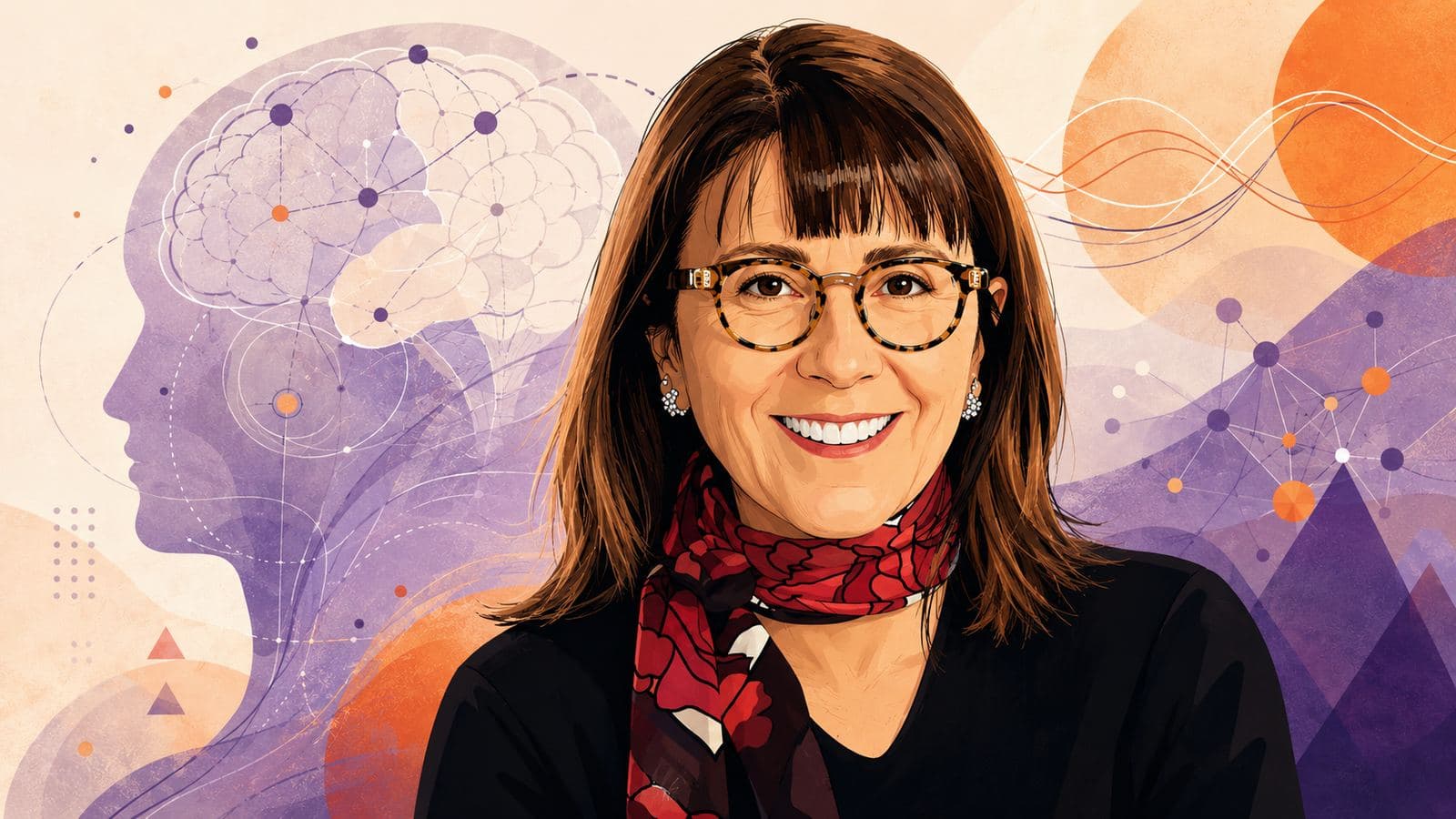
Lisa Feldman Barrett Simplified: How Emotions Are Made and the Body Budget
In this article
- Emotions aren't hardwired reactions that happen to you — the brain constructs them from prediction, body signals and context
- The body budget: your brain runs your body's energy like an account, and mood follows the balance
- Anxiety, in her telling, is often the brain's knee-jerk meaning for expensive uncertainty — and the same arousal can be retrained as determination
- Emotional granularity — a term she coined — measurably improves regulation, and 'regulate state, shift story' is the practical translation
Some scientists refine a field. A few overturn one. Lisa Feldman Barrett — University Distinguished Professor of Psychology at Northeastern University and among the most-cited scientists in the world for her work on emotion and the brain — belongs firmly in the second category.
Her argument, built across decades of research and two bestselling books, How Emotions Are Made and Seven and a Half Lessons About the Brain, sounds almost heretical the first time you hear it: your emotions are not built-in reactions that happen to you. Your brain constructs them. And once you understand how, you gain more influence over your inner life than the classical story ever allowed.
Here's her thinking, simplified — with her own words, drawn from her long conversations with Andrew Huberman, Chris Williamson and Steven Bartlett, doing the heavy lifting.
The classical view — and why she thinks it's wrong
The story most of us inherited goes like this: emotions are universal, hardwired programs. Something happens, a dedicated circuit fires — fear in the amygdala, so the story goes — and your face and body broadcast the result the same way in Auckland as in Alaska.
Barrett spent years looking for the evidence behind that story and kept finding the same result: it isn't there. Across hundreds of studies, no emotion shows up as one consistent fingerprint — not in the face, not in the body, not in the brain. As she put it on Modern Wisdom, the right question isn't whether your joy matches someone else's:
"Is your experience of joy on one occasion exactly the same as your experience of joy on another occasion? The answer is no… joy or anger or any other word for emotion really refers to a population of instances that are variable — not infinitely variable, but variable, and tied to the situation that you're in."
The variation isn't noise, she argues. The variation is the finding.
The big idea: emotions are constructed
Barrett's alternative is called the theory of constructed emotion, and it rests on a now-familiar foundation: the brain is a prediction machine. It doesn't passively receive the world and react; it constantly guesses what's about to happen and what your body needs, then checks the guesses against incoming signals.
In her account, an emotion is what happens when your brain makes meaning out of raw bodily feeling. The ingredients are simple:
- Affect — the body's constant, wordless weather report: pleasant or unpleasant, worked-up or calm. In her words, "a quick and dirty summary of the state of your body budget."
- Prediction — the brain's best guess about what this feeling means, here, now.
- Concepts — the emotional vocabulary your culture and history have taught you.
A pounding heart and tight chest before a presentation isn't intrinsically "anxiety." Your brain constructs anxiety out of those sensations — or, with a different prediction, constructs anticipation. Same body, different emotion, different morning. Her favourite proof is personal: she once famously mistook the flutters of a first date for attraction — "when really what I had was the beginnings of the flu."
The body budget
The concept of Barrett's that has travelled furthest — and the one regular readers will recognise as a load-bearing wall of this site's thinking — is the body budget, her accessible name for what physiologists call allostasis. On The Diary of a CEO she defined it in one breath:
"Your brain is running a budget for your body. It's not budgeting money — it's budgeting salt and glucose and oxygen and potassium and all of the nutrients and chemicals that are necessary to run an energetically costly body."
Sleep, food and movement are deposits. Effort, illness and conflict are withdrawals. And relationships, in her telling, are the quiet line item most people miss — trusted company literally lowers your running costs: "When you're with a friend who you trust, everything you do is just slightly less metabolically expensive." Then comes the line that summarises half of social neuroscience:
"The best thing for a human nervous system is another human — and the worst thing for a human nervous system is also another human."
The revelation is what happens when the account runs low. A depleted budget doesn't feel like a number — it feels like everything being worse. Even Barrett herself isn't exempt, as she admitted to Chris Williamson:
"When I'm at the end of the day and I have no spoons left and I'm exhausted, to me it feels like the world is ending… I just have to grab a hold of myself and say: okay, you're metabolically depleted. Go to bed. Get some sleep. Tomorrow will be a better day."
At the far end of that continuum, she's blunt: "Depression is like a bankrupt body budget… it's like bankruptcy." Sometimes the most psychologically sophisticated response to feeling terrible is not analysis. It's a meal, a walk, or an early night.
Anxiety, in her words
Barrett's account of anxiety follows directly, and it lands hard in an age of record anxiety numbers. The brain's biggest expenses, she says, are moving your body, learning something new — and dealing with persistent uncertainty. "Stress is just really your brain predicting a big metabolic outlay, because there's some effort involved." Uncertainty is effort that never resolves, and the modern world mass-produces it:
"Uncertainty is very expensive for a nervous system to manage… I think that we've engineered for ourselves the perfect environment to bankrupt a human nervous system."
When arousal spikes and the cause is murky, "the go-to, knee-jerk way of making sense of that is anxiety." But here's the hopeful turn — the same physical state can carry a different meaning:
"We automatically make meaning of this physical state as anxiety — but exactly the same physical state could be determination."
This isn't a slogan; it's an experimental result. She points to research by psychologist Jeremy Jamieson, who trained anxious test-takers to re-read their racing hearts as resources being mobilised — arousal stayed high, performance climbed. Barrett's favourite version comes from her daughter's karate test, where the sensei didn't say calm down, little girl. He said: "Get your butterflies flying in formation." As she explains: "Calming down would be the wrong thing to do… you don't want to be calm. You want that arousal." She's used the trick herself — heartbeats visible in her fingertips before her TED talk, filed under determination, not dread.
Granularity: precision is power
The second practical gift of her research is emotional granularity — a term she coined almost thirty years ago, now studied as a phenomenon in its own right. People who can distinguish "irritated" from "resentful" from "depleted" regulate their emotions better than people for whom everything is just "bad." A precise concept gives your brain a precise prediction, and a precise prediction suggests a precise response: resentment points to a boundary conversation; depletion points to bed.
This is trainable, which makes it one of the highest-leverage skills in the emotional life — and it's why "name it to tame it" practices have a real mechanism behind them.
What she is not saying
Barrett's theory is often misread, so two clarifications earn their place. She is not saying emotions aren't real — they're as real as money, which is also constructed and also runs the world. And she is not saying you can simply think your way out of feeling awful; construction happens fast and below awareness, and willpower — resisting that second piece of chocolate cake by gritting your teeth — is, in her words, the kind of control that "rarely works." What her science offers instead is leverage further upstream. As she told Steven Bartlett:
"You can't control everything that happens to you… but you have more control than you probably think you do. Everybody has more control over what they feel and what they do than they think they do."
That control doesn't look the way we expect — it's the budget, the concepts, the company you keep, the meaning you practise making — but it compounds.
Why this matters for how you work and live
If Barrett is right, the practical order of operations for a hard day reverses. First tend the budget — the state. Then question the construction — the story. That sequence, regulate state, then shift story, is the beating heart of the FLAME approach to well-being, and her science is the deepest evidence for why the sequence runs that way and not the reverse.
Where to go deeper
Start with How Emotions Are Made for the full argument, or Seven and a Half Lessons About the Brain for the short, beautiful version — her podcast conversations with Huberman, Williamson and Bartlett are masterclasses in their own right. Her ideas connect directly to the predictive brain and the capacity to update — because if your brain builds your experience from predictions, then curiosity, the willingness to update those predictions, is not just an intellectual virtue. It's an emotional skill.