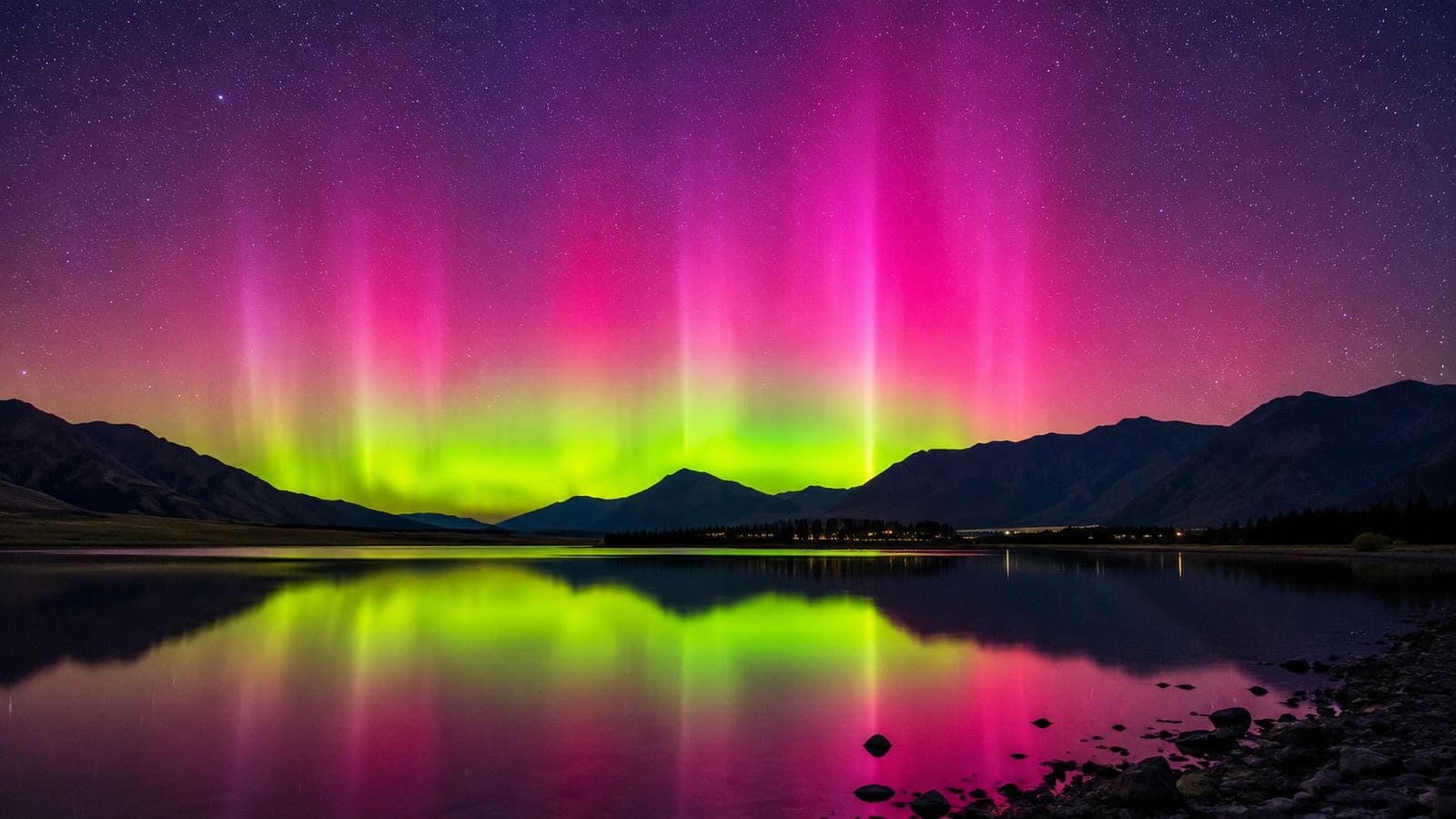
What Are the Southern Lights? And Why They Feel Like Magic
In this article
- The Southern Lights are solar wind meeting Earth's magnetic shield — the sky glowing because we're protected
- North and south get the same colours; from New Zealand you often see more pink because you're viewing the aurora's upper storeys
- Good nights can genuinely be predicted: solar cycles, CME warnings and the Kp index give hours to days of notice
- In Māori tradition the lights are Tahu-nui-a-rangi — and cultures worldwide read meaning into the glowing sky
People travel to the farthest ends of the Northern Hemisphere to catch a glimpse of the aurora borealis — Tromsø, Fairbanks, Iceland in midwinter, whole holidays built around the hope of a glowing sky.
What many people don't realise is that the same magic happens in the south. The aurora australis — the Southern Lights — is the mirror twin of the northern display, and one of the best places on Earth to see it is New Zealand. Tasmania catches it too, as do the far southern reaches of South America — Patagonia and Tierra del Fuego — when the displays are strong. The difference is that down here, hardly anyone is looking.
And the colours. The night sky speckled with stars, then the pinks and the purples pouring upward in slow curtains, and beneath them, along the horizon, the green. If that palette feels familiar, look around: it inspired the colours of this website — the pink-to-purple accents, the starlit dark, the green that arrives as you near the horizon of a page. When one of nature's most magical displays is regularly staged above your own country, you borrow from it.
But the science behind the lights is just as beautiful as the spectacle, and it deserves the deep dive. Here it is.
The physics: a battle you can see
The Sun is not a steady lamp. It is a churning ball of plasma that constantly boils off a stream of charged particles — electrons and protons flung outward at hundreds of kilometres per second. This is the solar wind, and it washes over Earth day and night. Every so often the Sun does something more dramatic: a coronal mass ejection, a billion-tonne belch of magnetised plasma aimed, occasionally, straight at us.
What stands between that torrent and everything you love is a magnetic field generated by molten iron turning in Earth's core. The magnetosphere deflects almost all of it, the way a boulder parts a river.
But near the poles, the field lines bend down toward the ground. There, some of those charged particles are funnelled along the field lines into the upper atmosphere, where they slam into the gases we breathe. The collisions pump the atoms full of energy, and the atoms shed that energy as light.
That's the aurora. The detail I find most beautiful: it is the visible signature of being protected. Those curtains of light trace the exact shape of the shield doing its job. The sky glows because something enormous is being survived.
The colours: a periodic table in the dark
Each colour in an aurora is a specific atom, at a specific altitude, relaxing in its own way.
- Green — the classic auroral colour — is oxygen at roughly 100 to 300 kilometres up.
- Red is also oxygen, but higher, where the air is so thin that atoms have time to release a rarer, slower glow.
- Pinks, purples and blues are nitrogen, typically lower down, often fringing the bottom edge of the curtains.
So when you look at a strong aurora, you are reading a vertical map of the atmosphere written in light. The pink-to-purple wash and the green horizon aren't decoration; they are chemistry, sorted by altitude.
Do the Southern Lights differ from the Northern Lights?
Physically, almost not at all — and that's the wonderful part. The aurora australis and aurora borealis are two halves of one phenomenon, lit simultaneously around each magnetic pole by the same solar wind. Scientists call them conjugate displays: when the sky erupts over the Southern Ocean, a near-mirror image is often dancing over the Arctic at the same moment. Subtle asymmetries between the two do occur, but you would need instruments, not eyes, to catalogue them. Same atoms, same colours, same physics.
What genuinely differs is the view. The auroral oval — the ring where the lights live — sits mostly over Antarctica and the Southern Ocean, so almost nobody stands directly beneath the southern display. From New Zealand you are usually watching from its outer edge, looking south at the aurora's upper storeys rising above the horizon — and the upper aurora is where the high-altitude oxygen reds and nitrogen-tinged pinks live. That's why Southern Lights photos from Otago or Southland so often glow pink and magenta, while a tourist under the oval in Tromsø sees green rippling directly overhead. Neither sky is more real. You're just seeing different floors of the same tower of light.
Can you predict a good night?
Better than you'd think. Aurora chasing has quietly become a forecastable pursuit, and the forecast works on three timescales.
Years: the Sun runs a roughly 11-year activity cycle, and displays cluster around each solar maximum — which is why the mid-2020s have delivered such spectacular shows, including the extraordinary storm of May 2024 that lit the sky across the entire country, photographed from Auckland driveways.
Days: the Sun rotates about every 27 days, so an active sunspot region that fired at Earth once often returns to aim again a month later. And when the Sun launches a coronal mass ejection our way, the cloud takes one to three days to arrive — which is how aurora alerts can tell you tomorrow night looks promising.
Minutes: spacecraft stationed upstream between Earth and the Sun measure the solar wind as it streams past, giving a final 30–60 minutes' warning of exactly what's incoming. That's the push notification that sends people running for their cars.
All of this gets distilled into the Kp index, a 0–9 scale of geomagnetic activity. From southern New Zealand, things get interesting around Kp 5; at Kp 7 and above, set an alarm. The rest is the old-fashioned checklist: a dark sky away from town glow, as little moon as possible, a clear view south, and the weeks around the equinoxes — March–April and September–October — when Earth's tilt makes the connection to the solar wind most efficient. Winter helps too, simply by offering more night.
One tip nobody mentions: your camera sees more than you do. In darkness your vision runs on rod cells, which detect brightness but almost no colour, so a modest aurora can look like a strange pale cloud. A long-exposure photo reveals the pink and green that were truly there. The colour was always present — your eyes simply couldn't afford to render it. What you perceive is never the whole of what is.
What the lights have meant: Tahu-nui-a-rangi and other stories
Long before the physics, people looked up at the glowing sky and knew it meant something.
In Māori tradition, the aurora australis is often known as Tahu-nui-a-rangi, commonly translated along the lines of "the great glowing of the sky". One widely told tradition connects the lights to ancestors: voyagers who travelled far to the cold south, whose fires are seen reflected in the night sky — the glow read as tūpuna lighting fires, a signal across the distance to their descendants. I won't pretend to speak for mātauranga Māori, and traditions vary between iwi — but I find it profoundly moving that the pre-scientific reading and the felt experience agree: the aurora arrives as a message from somewhere vast, addressed to the people watching.
Aboriginal Australian peoples, watching the same southern sky, wove the lights into their own traditions — in a number of accounts the aurora was associated with fire in the sky and treated as an omen, something powerful demanding respect. In the north, Norse tradition linked the borealis to Bifröst, the shimmering bridge between worlds, or to light glinting from the armour of the valkyries; many Sámi traditions held that the lights should be treated with quiet respect — you didn't wave, whistle or mock them.
Different hemispheres, different peoples, same instinct: this is not ordinary light, and it is not about you. Which brings us to the science of that instinct.
Why the aurora means something
I've spent years studying what the sciences of the mind say about human flourishing, and one finding keeps resurfacing: we need regular contact with things larger than ourselves. Researchers who study awe — the emotion the aurora reliably produces — describe what they call the "small self" effect: in the presence of vastness, our sense of self shrinks, our rumination quietens, and we feel more connected to other people and less burdened by our own concerns.
The brain, remember, is a prediction machine. It spends its whole life forecasting the next moment from the last one, and most of the time the forecasts are good enough that we barely experience the world at all — we experience our model of it. Awe is what happens when reality outruns the model. A sky that suddenly fills with moving light is a prediction error too large to ignore, and for a few minutes the forecasting quietens and you are simply there, updating.
That is why people drive four hours on a work night to stand in a freezing paddock in Southland. Not for the photograph. For the recalibration.
The lights are always on
One more thought to leave you with. The aurora doesn't switch on for our benefit. Somewhere over the Southern Ocean, on almost any dark night, those curtains are rippling above the water with no one watching. The solar wind arrives, the shield holds, the sky glows — an endless, silent performance for an audience of albatrosses.
We just occasionally get to look up at the right moment.
That, more than anything, is why this website borrows the aurora's colours. The work I care about — resilience, values, staying human in the age of intelligence — keeps arriving at the same conclusion: the conditions for wonder are always present, and the difference between a numb night and a magical one is usually just whether we had the capacity to step outside and look south.
If this made you want to chase a sky: start with a dark-sky forecast app, a winter new moon, and any south-facing beach below Dunedin. And if it made you curious about the machinery of wonder itself — the predictive brain that the aurora briefly silences — that's what my writing and keynotes are about.