The Future of Education
In this article
- Why mass schooling was designed for factory workers, not curious humans
- What Harvard and World Bank trials show about AI tutors lifting learning gains
- Which human skills the World Economic Forum says matter most by 2030
- A vision for schools as community hubs once childcare stops driving the day
- Why teacher well-being, not just technology, decides how children fare
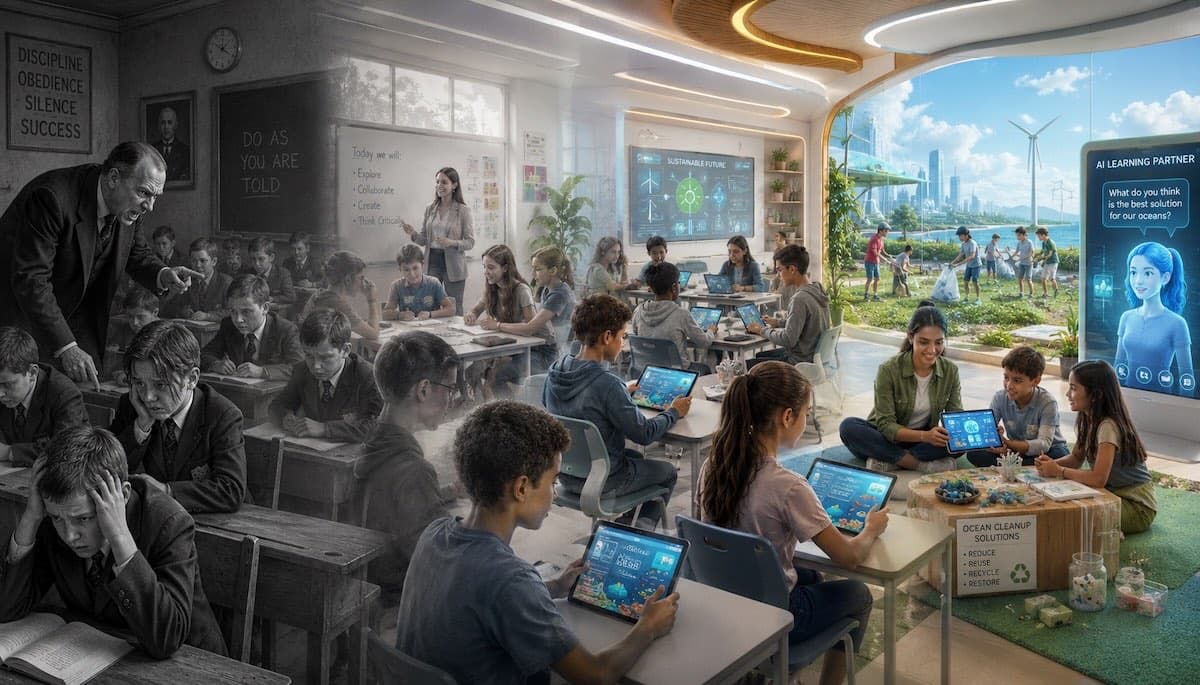
The school we treat as timeless is about 150 years old, and it was built to produce factory workers, not flourishing humans. As AI hands every child a personal tutor and parents come home, we get to ask a question we have not seriously asked since the Industrial Revolution: what is education actually for? The answer does not close the schools. It sets them free.
The first thing my school taught me was fear.
I grew up in Durban, in a school modeled on the British system of the late 1800s, in an era when corporal punishment was not only permitted but expected. It was legal in South African schools until it was banned by the South African Schools Act in 1996. I was not at a rogue institution. I was inside a system functioning exactly as it was designed to. It was brutal, and I struggled in it.
I received "the cane" many times. You'd wait outside the deputy principal's office in your blazer, tie, and charcoal trousers, in 30-degree heat, waiting for your turn. The door would open, and you'd be ushered into a dusty room, where an old man you'd never even spoken to would run a piece of chalk down his cane, so that the line from the first strike would provide a target for the second, third, fourth, and beyond. Afterward, you'd say, "Thank you, sir," and exit back into the sticky heat, in pain, plotting revenge, and somewhat relieved. I wasn't actually badly behaved — but I did question the rules and rigidity. That has become a feature, not a bug, in the age of intelligence.
I open there for a reason, and it is not the reason you might expect. Some of the people I admire most are teachers and principals. I work with schools constantly, often without charge, because I believe that if we can help teachers be well, resilient, and mentally fit, they will model those qualities for every child in the room. My argument is not against schools, and it is certainly not against teachers. It is against a model built for factories and run on fear. The buildings can stay. What happens inside them is what has to change.
Because we treat school as though it were a natural feature of childhood, as permanent as weather. It is not. Mass compulsory schooling is a recent invention, and we can see precisely why it was built.
Prussia mandated it in the 1760s. The United States built common schools in the 1830s. England's Elementary Education Act of 1870, the Forster Act, made schooling compulsory by 1880, and the motive was stated plainly. Forster told Parliament that "upon the speedy provision of elementary education depends our industrial prosperity." We did not build schools to help children become themselves. We built them to make the workforce literate, numerate, punctual, and obedient enough for the factory floor. The rows of desks, the bells dividing the day, the batching of children by age, the rewards for sitting still and the punishment for stepping out of line: this was an industrial design for an industrial need.
It had a second function we rarely name. School was childcare. It synchronized children's days to the factory shift so that parents could go and work. For 150 years, the school-shaped day has solved a logistics problem far more than an educational one.
Here is the contention this piece will make. In the age of intelligence, the thing school was built to produce, a compliant and standardized worker, is exactly what the economy no longer needs. And the things the factory model tends to grind down, curiosity, creativity, and the courage to be wrong, are exactly what it now needs most. We built the wrong machine. The good news is that the people inside it, the teachers and the children, are precisely who we need to build the right one.
A pattern, and possibly a break
Education itself is ancient, and it began as survival. One generation taught the next to knap flint, weave a mat, tan a hide. Every time a tribe or village perished, a library of hard-won skill vanished with it, and the loss is one of the great untold tragedies of our species.
Then agriculture created surplus, surplus created time, and time let us do what humans do best: learn, create, and abstract. We invented writing to keep ledgers of who owed what, and once knowledge moved beyond what a parent could teach at the hearth, we needed specialists. Greek and Roman tutors formalized it. The Industrial Revolution scaled it to everyone. And then, as we always do, each generation made the curriculum more complex and abstract than the last, until a degree became a near-requirement for a job, and people chased degrees that often had little to do with the careers they landed in.
The educator Ken Robinson saw where this led. His 2006 talk, Do Schools Kill Creativity?, remains the most-watched TED talk ever, and back then he was already arguing that academic inflation was hollowing out the value of degrees and that schools systematically educate children out of their creativity. He warned that we were preparing children for a future no one could predict using a system designed for a past that was already gone.
So the question that runs to the end of this piece. Every era added a layer of abstraction onto education. AI has now ingested all of those layers at once, and performs in the top few percent of nearly any skill we used to spend years teaching. Is this just another layer, or is it the moment the thing we optimized for becomes obsolete?
Where education actually stands in 2026
Look at the system today and you find a contradiction it cannot hold much longer.
The credential is cracking. Only about 27 percent of college graduates work in a job closely related to their major, according to the Federal Reserve Bank of New York. Roughly three-quarters end up in unrelated careers. More than half of recent graduates are underemployed, working jobs that do not require a degree, and many stay stuck there for a decade. Employers, meanwhile, are dropping degree requirements outright.
At the same time, AI has read essentially everything humanity has written and performs at the top percentiles, while young people graduate carrying enormous debt and a skill set whose most durable asset is the ability to learn, which everyone already has. And the institutions meant to prepare people for this moment are often the slowest to face it, with some still dismissing AI as a machine that "just hallucinates" while their own students use it every day to learn.
If the credential no longer signals competence, and the content is now free and infinite, the question is unavoidable. What is school for?
Three horizons
No one can describe 2040 with a straight face. The discipline is to be honest about confidence. The near term is forecastable. The middle term has a real consensus. The far term is open, and that is where judgment, not data, does the work.
Now to 2027: already happening
The personal tutor arrives for everyone. In 1984, the researcher Benjamin Bloom showed that one-to-one tutoring could lift an average student into the top few percent, but no society could afford a tutor for every child. AI changes that arithmetic. A 2025 Harvard randomized trial found a well-designed AI tutor doubled students' learning gains compared with in-class active learning, with 83 percent rating its explanations as good as or better than a human instructor's. A World Bank trial in Nigeria produced gains equivalent to about two years of ordinary schooling in just six weeks.
The crucial detail, and the one that decides everything that follows: those gains came from the scaffolds and guardrails that teachers designed around the AI, not from the raw algorithm, and UNESCO treats human oversight as mandatory. The model that works is a copilot. AI plus a human. The machine personalizes the mastery; the human supplies the judgment, the motivation, and the care. Meanwhile the degree keeps losing its grip, hiring shifts toward demonstrated skill, and the curriculum visibly trails the abilities employers actually want.
Toward 2030: the consensus
The skills that endure are the human ones. The World Economic Forum's Future of Jobs Report 2025 finds that 39 percent of core work skills will change by 2030, and that the fastest-rising human capacities are creative thinking, resilience, flexibility, curiosity, and lifelong learning. The soft skills have become the hard skills, and they are precisely the ones a standardized classroom is worst at growing.
The teacher's role shifts from lecturer to mentor and coach, because the lecture is the part AI now does best. And the system begins to splinter. Homeschooling has reached around 3.4 million US students, roughly 6 percent of the school-age population, up from 2.5 million in 2019. An estimated 95,000 microschools and learning pods now serve over a million students. Families are not waiting for permission.
2030 to 2040: the open questions
Past 2030 nobody plants a credible flag, so these are my bets, offered as wagers, and they share one thread: who decides what a child learns, and who they are allowed to become.
The factory day ends, and the school is reborn. School's hidden job was custody, freeing parents to work. As automation and universal basic income bring more parents home, that rationale collapses, and the question "but who will watch the children?" answers itself. This does not empty the schools. It frees them. Picture the campus reimagined as a community hub, closer to a small university than a factory floor: elective classes anyone can choose, examinations and specific lessons for children who learn mostly at home, drop-in workshops, visiting artists, and the full range of sport. A place where the local experts who teach in the community could train as trainers, cross-pollinate, and connect. This may be exactly what stops principals and teachers from burning out, turning the school from a place of compliance into a place of joy.
The school becomes a sanctuary for teachers too. If teacher well-being is what gets modeled in front of children, then caring for teachers is not soft, it is strategic. I have been helping build a hauora room at a local school, drawing on the Māori understanding of well-being as a whole, a space where teachers can meet, calm, and restore themselves. We need far more of that. A school that heals the adults inside it will heal the children inside it, because resilience is caught, not taught.
Village-style learning circles. Even in cities, small community groups where adults teach children real skills, with an AI layer handling assessment and quality. The neighborhood's hidden experts come out of the woodwork, the real estate agent who once played professional rugby, the accountant who nearly made the Olympics as a kayaker, and our children get expert mentorship firsthand. We do not abandon algebra; we let the local person who loves it teach it to the children for whom it sparks.
Project-based, not role-based, all the way up. Here is the piece I have not spelled out before, and it is the one that excites me most. The future of work itself is becoming project-based: collectives of people, supported by robots and intelligence, focused on a real mission, cleaning a river, rebuilding a coastline, curing a disease. Education should feed straight into that. Children work on their own projects in the circles, projects that scale up through intensives until they flow naturally into the big one. You graduate through a genuine rite of passage, a ritual of becoming, restoring the markers of growing up that modern life has erased, and you are ushered into the main project as a young adult. Some will be immersed in the real mission far earlier. Mastery, shown through real work, is the new diploma.
Many models, not one. None of this is a single prescription. New Zealand has wilderness schools where children spend the whole day in nature. That would suit some children and, frankly, my own daughter would hate it. That is the point. There are many models of learning still unexplored, and the task is not to pick the one true school but to shift our belief about what is normal and what is possible.
Holistic, not disjointed. Knowledge reweaves into wholes. Give a child a project, write the story of Alexander the Great, and history, geography, mathematics, art, and writing all connect inside one task that means something. Because life is holistic, and learning should be too.
The dots most forecasts miss
- The credential vacuum. Kill the degree as a signal and something must fill the gap. The answer is the portfolio of real work. Project-based learning stops being a pedagogical nicety and becomes the new proof of competence.
- The purpose inversion. Remove "school as job preparation," especially under UBI, and education's reason for existing flips from earning to becoming. It returns to what the privileged always used it for: the making of a whole, curious, capable human.
- The objections worth meeting head-on. Two are coming. First, socialization: school's social fabric is real, and "keep kids home" sounds like isolation, which is exactly why the reborn-school-as-hub and the community circles matter, since they offer more connection, not less. Second, equity: engaged parents and rich mentor networks are not evenly distributed, and a future that works only for the child of an author is no future at all. The reinvented public school, free and open to all, is what keeps this from becoming a privilege with better branding.
The human premium
Notice where every thread lands. As AI takes over the delivery of content, and does it better than a classroom ever could, all the value migrates to the things content was never the point of. The mentor. The community. The teacher who sees a child clearly. The adult who helps them discover what lights them up.
This is why the teacher matters more in this future, not less. The capacities that endure, curiosity, resilience, belonging, and purpose, are exactly the ones a tired, frightened adult cannot model and a well, supported one can. AI can finally give every child the personal tutor Bloom imagined, which frees the humans among them to do the only work that was ever truly ours: to nurture meaning, character, creativity, and connection. And it raises a question I cannot shake. We are working hard to stop adults from burning out at their jobs. Why, then, do we subject our children to a miniature version of exactly that, the targets, the ranking, the fear, the grind, the very pattern we are trying to heal in the adult world? There is a better way.
Which brings me back to the boy in Durban. What that classroom beat into me was compliance. What I would have run toward, if anyone had offered it, was a project like the tale of Alexander the Great, and I would have taught myself everything required to make it real. I think about that now as a father, watching my own daughter, who is curious and kind and alive at home, come back from school a little smaller than she left. The future I am describing is not a fantasy. It is the education I needed and never got, and the one she deserves.
What this means on Monday
For parents and educators, let AI carry the mastery and the personalization, and spend the human hours on mentorship, curiosity, and connection. Protect play and psychological safety as deliberately as you adopt the technology, and protect the teachers too, because a well, resilient adult is the most powerful curriculum a child will ever have.
For leaders and learners, the skills that compound are the ones AI feeds rather than replaces: learning how to learn, creativity, curiosity, and collaboration. Stop optimizing for the credential and start building a portfolio of real things made and real problems solved.
What education is for
We strip-mined children's minds, as Ken Robinson put it, for a single narrow commodity, and that commodity is now manufactured better, faster, and almost for free by machines.
That is not a catastrophe. It is a release. For a century and a half we ran an education system built to serve factories, and we mistook it for the natural shape of growing up. The factories are closing. The fear can end. We do not need to tear down the schools; we need to set them free, to become hubs of curiosity and community where teachers are restored rather than depleted, where children chase real projects into real missions, and where the day is shaped by wonder rather than by a bell. We were never really in the business of filling minds. We just forgot, for about 150 years, that we were always meant to be lighting them.