Suffering Is a Story
In this article
- One event can be told as three different stories, and only the first of them is suffering
- The second arrow is the meaning we add after the event, and it is the one we fire at ourselves
- Small stories can be rewritten in the moment by stripping them back to the facts
- Big stories need to be finished, and that sometimes takes counselling, therapy or other support
It's a beautiful, crisp spring day. As I emerge from the local mall, I look at my phone, select a podcast for the walk home, and smile at a passing stranger. I feel the phone buzzing in my pocket. I look down, pull it out, and suddenly the world is in a slow-motion slide as I find myself hurtling towards the pavement.
I land, and there's that moment of recalibration as the brain seeks to update its model of what just occurred. I roll over to a seated position and look at my hands, which have a few little pieces of stone embedded in them, and then the pain from my knee makes its way to conscious awareness. I look down, and indeed there is a large graze, with blood just starting to seep through.
Immediately, I think: this is bad. I'm losing my sense of balance. I must be getting older. Oh my gosh, I'm not going to be able to go to the gym tonight. This is going to take ages to recover. What if it gets infected? What if the waves get good over the next week? This is just me being stupid, as usual.
I stand up, dust myself off, and start walking home. Hang on a second. It's her fault. Why did my wife have to call me? She distracted me. That's why I tripped over the pavement and fell. It's her fault. She always does this, and she probably had nothing important to say. In fact, I'll call her right now and give her a piece of my mind.
Now let's pause. Can you see what happened? There was an event, and there was pain, but I've created a story of victimhood, of blame, of the world being against me. If I replay the story, it becomes suffering. But there is another story available to me, and it's actually really elegant. Let's try it.
I got distracted while receiving a phone call. I wasn't looking where I was going and tripped over a bump in the pavement, and now I've got a cut on my knee.
There we go, in its simplest form. That's what happened. There are no villains, there's no self-criticism, and there's no blame. It's just what happened. It is what it is.
But there's a third story available, which is that this was an important reminder to pay attention, and the event could have been much worse. Imagine if I had tripped in the middle of the road rather than on the pavement, and been hit by a car. In fact, I'm really grateful that it happened on the pavement, and I'm also grateful to have a wife who cares about me, who phones me. As I discovered later on, she was calling to remind me about an important meeting that I would otherwise have forgotten.
In reality, there was one event (a pavement, a knee) with three possible experiences:
- The first book on the shelf saw me blaming the world, being a victim, and crafting a story that I could easily play on repeat about my misfortune.
- The second book, which sits on the same bookshelf, is where I simply describe what happened.
- The third book on the bookshelf is the one of full responsibility, and of finding something to be grateful for despite the pain.
Sometimes we try to jump from the first book to the third, and that doesn't always feel authentic. However, being able to look at things as they are, not tinted by rose-coloured lenses or by the negativity bias, might be the bridge: establishing the facts about the event and then assigning what it means.
The second arrow
Over the course of our lives, we will all experience adversity and stressors, pressure and intensity. But what turns these experiences into suffering is the meaning we give to those events, and the story that we tell in order to fit them into the context of our lives.
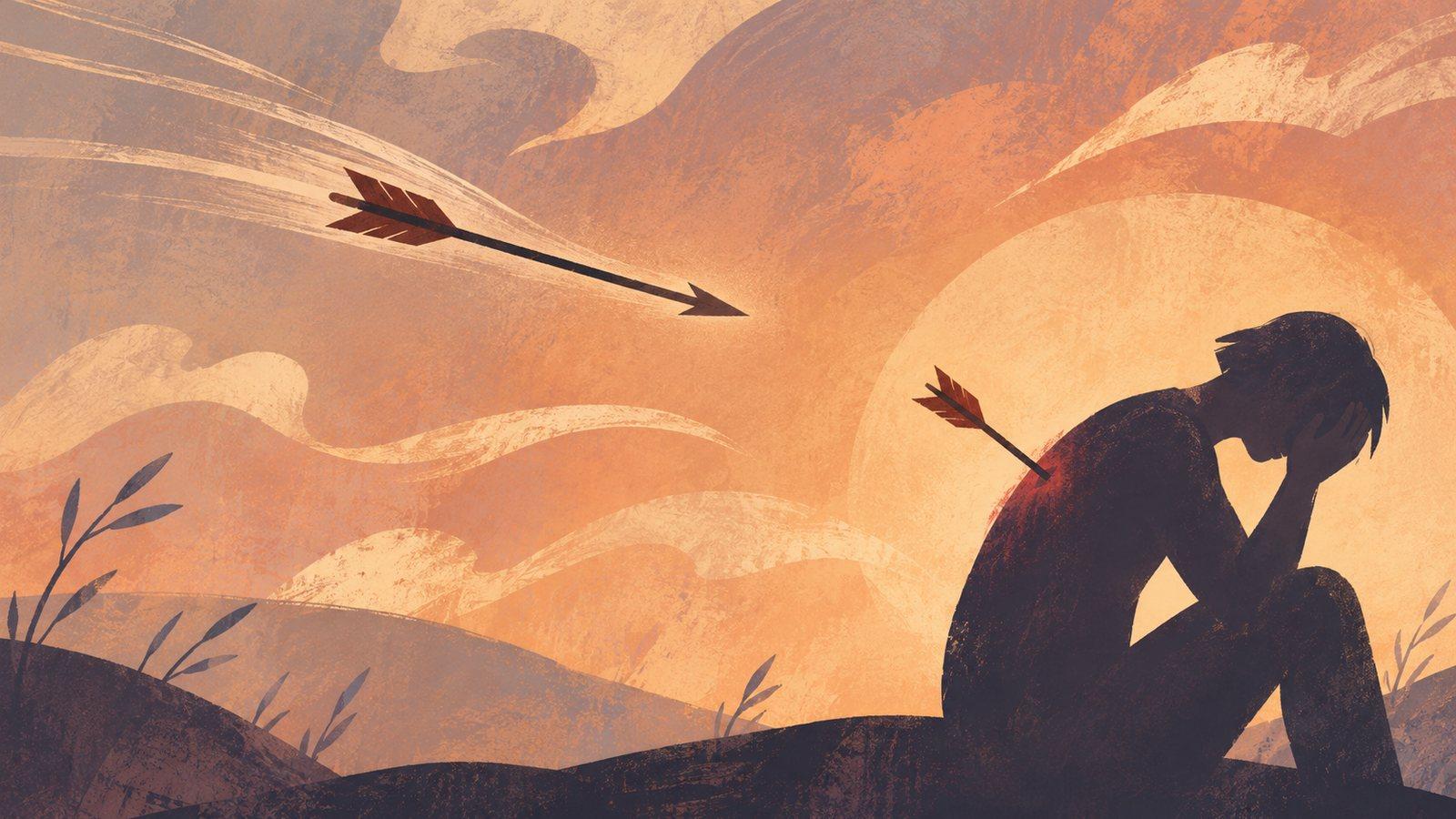
The cut on my knee is painful in all three versions of that story, and the pain is very real. The physical injury will probably leave a scar, and I won't be able to go to the gym tonight. But what changes is all the load I pile on top of the event. Buddhist teachers call this the second arrow. The first arrow is the event, and the second arrow is the meaning we assign to it, and that is the one we usually fire at ourselves afterwards.
Epictetus, a Stoic philosopher who taught almost 2,000 years ago, highlighted the same point: people are disturbed less by events than by their judgements about those events. Modern stress research, unsurprisingly, agrees. Richard Lazarus and Susan Folkman showed that the way we appraise an event shapes the stress we feel in response to it.
Here is my perspective: suffering is a story. But there is a caveat. Some suffering is more than a script or narrative. Chronic pain, depression, fresh grief, and continued harm or abuse don't simply change because we change our story. But a great deal of life's suffering is the second arrow, and this is where you can become an author of your experience and a more effective narrator of your life's journey.
Rewriting the small stories
I think what makes humans unique is our ability to tell and consume stories, including the stories we tell ourselves about everyday misfortunes, such as the pavement incident, a sharp email from a manager, or the flight we missed because of traffic. We can rewrite these relatively easily, in the moment. This involves catching a story as it's being written and then stripping it back to the facts. Remember book two: the reality of the event. Then we can put it in perspective and choose what that event actually means.
When it comes to everyday mishaps, that first arrow has landed, and of course we feel the pain or discomfort. Remember that the second arrow is whistling through the air, and that is the arrow with the voice that says, "It's her fault, and I'm stupid, and this always happens to me" (what we sometimes call thinking traps). With practice, you can catch that second arrow or duck beneath it. I like to think of catching it with cat-like reflexes and snapping it over my knee, ideally the one without the cut, before it lodges in me.
This is a mindset of personal responsibility: the ability to step back and say, "I own my experience, both the good and the bad." When I do that with my knee, for example, rumination (thoughts of the past played on repeat) loosens its grip. Eventually, and often rather quickly, there is no story left to replay. There was an event. I shaped my own meaning of that event.
Finishing the big stories
Really unfortunate events happen, and sometimes we can't get to book three all alone. Some people experience car crashes and need years of physical rehabilitation. Even worse, some people are subjected to abuse, violence or assault, and they need rehabilitation too. We do not choose these events, and we do not need to own them.
Though I have to say, I have seen people make major breakthroughs by owning not the adversity, but the story that they tell themselves about that adversity. I'll be honest here: I am one of those people. This is not hypothetical, and I tell some of it in the introduction to my book, Start with Values.
Here is my story. I was born to a mother who was barely 18 years old. Her hopes and dreams of university and a career as a journalist were shattered. My parents were on the fence as to whether to give the baby up for adoption or to keep him, and there was a lot of pressure for me to be given up.
Eventually, however, my father's Catholic family convinced my parents to keep me, to get married at the tender age of 18, and to grow up incredibly fast. My father's dreams were dashed too, as he was on track to play competitive cricket overseas. Instead, he became a lumberjack, and my mother became a housewife. She took much of her frustration out on me.
As a child in those types of situations, you develop survival skills that you really shouldn't need to develop. You become acutely aware of changes in mood, and of how you contribute to that change in mood. Of course, you learn to suffer in silence. I replayed that story of my youth so much that eventually it became my identity.
There's a slippery slope from event to story to identity, and it prevents you from making the most of your life. What I want to say is this: you are not responsible for what happened. You are the author of what it means. When you are ready.
There's a narrative structure called the hero's journey, popularised by the mythologist Joseph Campbell, who found that a great many stories share a set of phases. There's a call to adventure, where an often unwilling protagonist steps across the threshold to engage in a journey of growth or adventure. They find some allies, learn new skills, test themselves against real challenges, perhaps encounter a real crisis, then integrate what happened and return home to share the story, potentially becoming a mentor for others.
Sometimes we get caught between the struggle and the crisis, bouncing back and forth without reflection or integration, sometimes without even having friends or allies, and without learning new skills or growing. In this case, our story never reaches the later chapters. After the crisis, we sometimes don't get help, we don't integrate, and we don't recognise that our adversity and our struggle were part of the story, not the whole story. This is where counselling, therapy and trauma-informed support matter.
In summary, small stories can be rewritten, and we can do it on the fly by asking, "Am I in book one, book two, or book three?" The big stories need to be finished, and sometimes finishing requires support. Research from the psychologist Dan McAdams found that people who tell redemptive stories, in which a hard chapter leads somewhere good, tend to report higher wellbeing. James Pennebaker's studies show that writing about a painful experience until it forms a coherent account is linked with better health.
We're not necessarily saying you should keep replaying your trauma, which may, in fact, be deleterious. It's really about placing it into perspective and writing a better story, and narrative therapy shows real promise here.
Back to my struggle. I was caught in a loop for a long time, and it took me many years to actually step back and recognise that my own mother had real struggles of her own. While certain forms of trauma, including assault, should require that the perpetrator is held accountable for their actions, there may, in some cases, be room for compassion.
When I realised that my 18-year-old mother was still, in very many ways, a child, I felt a sense of sorrow for her. I understand how hard it must have been to let go of her own dreams. Swapping journalism for nappies must have been incredibly depressing.
Along the way, I learned to stop blaming her. I learned to forgive, though perhaps not to forget certain patterns. This has been rather adaptive, because what have I gained from a tumultuous childhood? Deep empathy, and an incredible sensitivity to other people's state. This is a superpower in workshops and seminars. I have a desire for peace, and to be a calming influence in the world. I want to help others. Would I be this version of myself without the adversity? Perhaps not. The survival skill that I shouldn't have needed as a child turned out to be the same skill I use to help people now.
Many of the most effective healers, therapists, counsellors and mentors that I know have experienced trauma themselves. Somewhere in their own integration, they realised that their purpose was to help others in similar situations. Carl Jung called this the wounded healer, and perhaps it's the last phase of the hero's journey: returning home to share the story, becoming a mentor or ally for others who are navigating their own path.
No one chooses the wound, and the wound doesn't help anyone. It's the finished story that becomes a model for others.
A wider perspective
Sometimes I think that zooming out to the level of the cosmos gives us perspective, because the universe is a great unfolding. It's a process. We are not individuals, all alone in a chaotic world. Life is a process. Physics and chemistry make patterns, and some of these patterns have emerged as conscious living beings, such as us.
It's so wonderful when you realise the fragility of life, doing the best it can to hold off entropy. Every cell in our bodies is striving to keep the whole organism functional, to provide energy, to provide us with an opportunity for experience. Part of that experience will be joy, and part will be loss. There'll be scraped knees, and there'll be heartbreak. There'll be love, and there'll be sorrow.
While we can't eliminate adversity, we can check the story that we tell ourselves. Suffering is a story. Some of us are stuck rereading and retelling one chapter, but it's important to recognise that we don't have to read the same book for our entire lives.