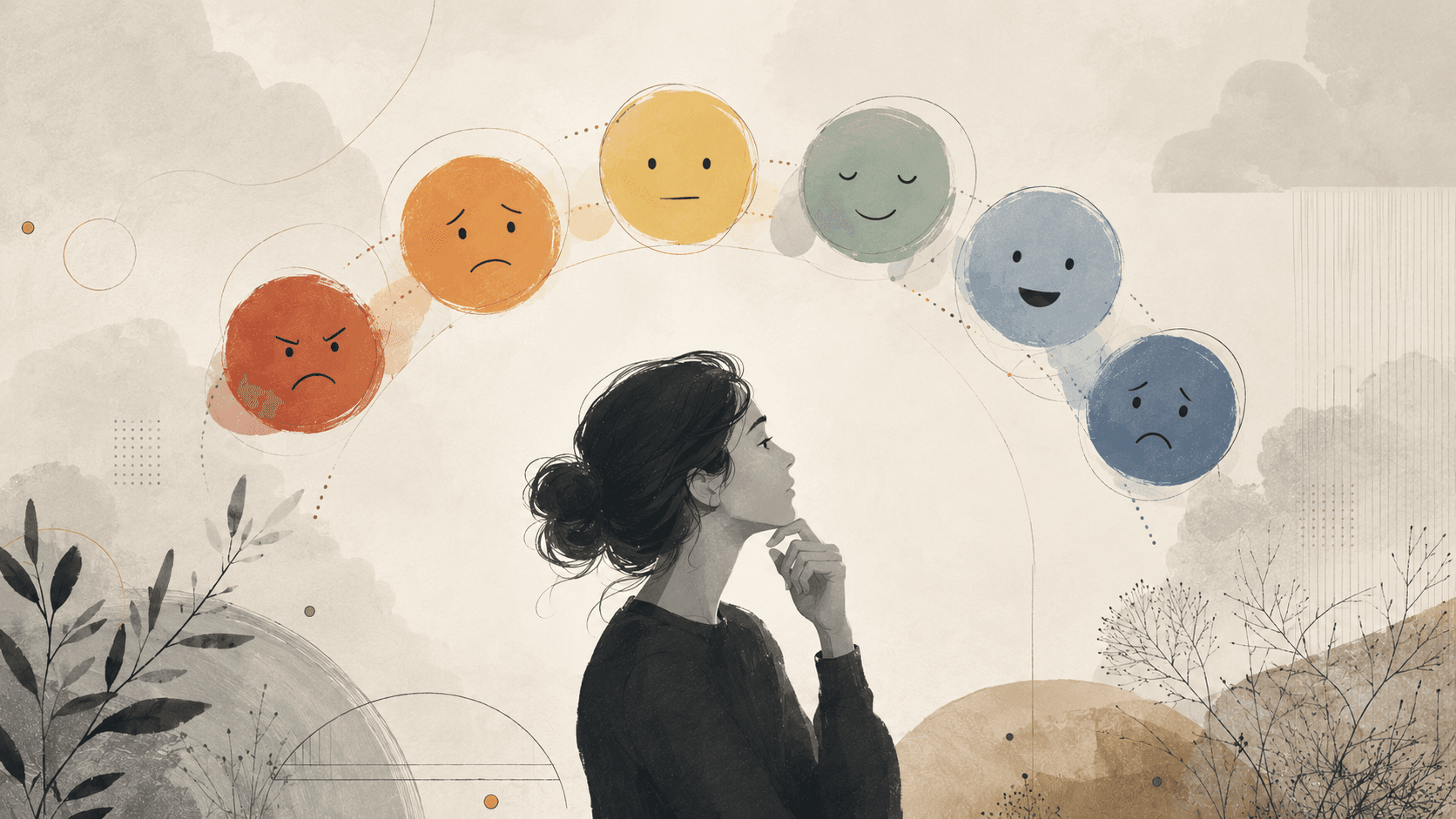
The Emotion Wheel, Explained: Name It to Tame It (Interactive)
In this article
- An interactive emotion wheel you can use right now — hover or tap from six core feelings out to precise words
- The research: labelling an emotion measurably calms the brain's threat response
- Why precision beats positivity: emotional granularity is the trainable skill underneath the wheel
- The constructed-emotion nuance: wheels aren't a periodic table of feelings — they're a vocabulary kit for your predictive brain
Somewhere between "I'm fine" and what's actually happening inside you is a missing word. The emotion wheel exists to help you find it — and the reason it works is better than most people who share it realise.
This guide covers the wheel itself (a working one is just below — try it), where it came from, and the neuroscience of why naming a feeling changes the feeling. Not the poster version: the real mechanism.
Try it: the wheel
Hover the wheel on desktop, or tap through on your phone. Start at the centre, drift outward until a word clicks, then say the sentence in the middle out loud.
The label alone turns the volume down. Precision turns it down further.
This wheel comes from the FLAME toolkit — six core feelings, each opening into five broader states and ten precise words. Notice something as you use it: the more specific the word, the more useful it is. "Bad" tells you nothing about what to do next. "Resentful" points at a boundary. "Depleted" points at bed.
Where emotion wheels come from
The idea has three main ancestors.
Plutchik's wheel of emotions (1980). Psychologist Robert Plutchik arranged eight primary emotions — joy, trust, fear, surprise, sadness, disgust, anger, anticipation — as opposing pairs on a flower-like wheel, with intensity rising toward the centre (annoyance → anger → rage) and adjacent emotions blending into "dyads" (joy + trust = love). It's the theorist's wheel: a model of how emotions relate.
Willcox's feelings wheel (1982). Therapist Gloria Willcox built hers for the therapy room: a simple centre of core feelings opening outward into the precise vocabulary her clients couldn't find on their own. Most wheels shared today — including ours — follow her design logic: it's not a theory of emotion, it's a finding aid.
The Geneva Emotion Wheel. Klaus Scherer's research group in Geneva built a version for science — a standardised instrument that lets researchers measure emotional responses consistently across studies and languages.
Three wheels, three purposes: modelling emotions, finding words for them, and measuring them. The one on this page is unapologetically in the Willcox tradition — built to be used.
Why naming works: the science
"Name it to tame it" — psychiatrist Dan Siegel's phrase — sounds like a fridge magnet. The evidence behind it is anything but.
In a well-known UCLA study, neuroscientist Matthew Lieberman and colleagues showed people distressing images while scanning their brains. When participants simply labelled the emotion in what they saw — choosing a word — amygdala activity dropped while the right ventrolateral prefrontal cortex, a regulatory region, lit up. Putting feelings into words, the researchers concluded, disrupts the brain's threat response. Affect labelling has since shown benefits everywhere from public-speaking anxiety to spider phobia: the label alone turns the volume down.
Then comes the finding that explains why the wheel's outer ring matters most. Lisa Feldman Barrett — whose work we've covered in depth — coined the term emotional granularity for the ability to construct finely differentiated emotional experiences. Across her research, high-granularity people — those who can tell irritated from resentful from depleted — regulate emotion better, cope better under stress, and even show better health outcomes than people for whom everything is just "good" or "bad." Granularity is a skill, and the wheel is literally a training device for it.
The nuance: a vocabulary kit, not a periodic table
Here's where this article parts company with most emotion-wheel posts, and it's the part worth understanding.
The classic wheels quietly assume the old story of emotion: that a small set of basic emotions is built into everyone, and the wheel just maps the natural kingdom. Barrett's theory of constructed emotion argues something different: emotions aren't triggered from hardwired circuits — your brain constructs them, predictively, from body signals, context and the concepts you've learned. In that view there is no fixed number of emotions to put on a wheel, and no wheel is the "correct" one.
So does that undermine the wheel? The opposite — it explains why it works. If emotions are constructed from concepts, then your emotional vocabulary is part of the machinery of your emotional life. A new, precise word isn't just a description of a feeling; it's a new tool your predictive brain can use to make different meaning of the same bodily state — and different meaning means different action. The wheel isn't a map of what's inside you. It's a kit for building better predictions.
Both research traditions — basic-emotion and constructionist — disagree about deep mechanics and agree completely about the practice: labelling helps, and precision helps more.
Using it in real life
- Mid-conflict: pause and name what's actually present — "frustrated" lands very differently from "hurt," and each suggests a different next sentence.
- With kids: the wheel is an emotional-vocabulary curriculum in one image. Naming together beats "calm down" every time.
- In journals or check-ins: replace "How am I? Fine" with one trip around the wheel. Two words from the outer ring beat a paragraph of vague.
- For teams: opening a hard meeting with one honest word each takes ninety seconds and changes the meeting. (This is the wheel's role in Brad's wellbeing keynote — emotion regulation as infrastructure, not soft skill.)
- For someone else: use the wheel to form a guess about what a colleague or partner might be feeling — then check gently. Ask, don't tell. Empathy, it turns out, is mostly better guessing plus the humility to verify.
One caution to keep it honest: labelling is a regulation skill, not a cure. If what you keep finding on the wheel is heavy and persistent, the powerful move is the same one the research supports for everything else — say the words to a professional who can help.
The bigger picture
Emotion regulation sits near the centre of the map of fields behind this site, wired to the predictive brain, to polyvagal theory, to the body budget. The wheel is the smallest possible entry point into all of it: one honest word, said out loud, is a prediction updated — and as regular readers know, the capacity to update is the whole game.
The interactive wheel lives permanently in the FLAME toolkit alongside other workshop tools — and if you'd like it live on stage with the science told properly, that's a keynote.